Category Archives: Music

Poet in Mind: Her Accompanying Poetry – Rhoda Coghill

My father was a lifetime member of ACDA (the American Choral Directors Association), and despite his passing several years ago, I’ve continued to receive monthly copies of their flagship publication, The Choral Journal. Even though I am not a choral director, I find it a calming connection to my dad’s interests, in a way, and sometimes I learn something new.


For example, I recently read an article in the August issue of “The Choral Journal” about the problems and possibilities of Irish choral music. The article largely lays out the argument that Irish choral music is sparse due to the non-indigenous nature of “native” choral music in Ireland. This is partly due to Irish music’s historical development of ornamental solo melodies coupled more with unison responses; however, subsequent development is complicated by the cultural implications of British colonialism and the suppression of the Irish language, and the long polarizing battle over religious preferences. That many Irish themes in choral music are largely the work of British composers is unique to this environment.

Within the article, the author identifies that there are a small number of Irish-born composers that deserve more mention in the history of Irish music composition, and in particular, choral composition. One of these – Rhoda Coghill – is who I want to feature in this “Poet in Mind.”

Rhoda Coghill was born in Dublin on October 14,1903. She was the youngest of eight children. Her father was a Scotsman who worked as a printer, and her mother was a Dublin native. Rhoda displayed musical ambition at an early age, beginning piano lessons at the age of eight. She was talented and considered a prodigy. By the time she was 22, she had amassed twenty-one prizes at the Feis Ceoil [fesh-k’yole], an Irish classical music festival to encourage native Irish performers and composers.

Over her lifetime she was a sought-after soloist and accompanist and served as the primary accompanist for Radio Eireann. She was self-taught as a composer, composing piano pieces, selections for voice and piano, and arrangements of Irish folk songs. Arguably, her best-known work was composed when she was twenty years of age in 1923. It was a rhapsody for Tenor, choir, and orchestra, entitled “Out of the Cradle Endlessly Rocking.” The work uses text from the poem by Walt Whitman. Coghill was a student at Trinity College, Dublin at the time, and being just after the conclusion of the Irish civil war, the work was unable to be performed due to inadequate orchestral resources. The work wasn’t fully performed live until 1990.

As mentioned previously, Coghill composed a number of original pieces based on Irish poetry. She specifically used several George Russell and Padraic Colum poems. Two examples are A Ballad Maker, by Padraic Colum and Refuge, by George Russell. Her poetic tendencies in composition fell toward the romantic and beauty in nature. Her attempts to be taken seriously as a composer were met with a certain ambivalence typical of the period towards women. She had conquered music as a performer and held a respected position as accompanist for the state radio; however, acknowledge of her compositional successes were not to come in her lifetime.

Coghill began writing poetry in the 1940s. She only published two small poetry collections in her lifetime: The Bright Hillside (1948) and Time is a Squirrel (1956) and, sadly, both are out of print. I’ve only been able to find excerpts that were used in the references. She wrote from a musician’s point of view, with phrasing and thematic elements that are expressed in rhythm. Her work was praised as a new voice at the time of publication. Several of her poems are gendered female and express the stark societal expectations of Irish women during the early 20th century: forced into marriage with older, more financially secure men, having very little control over their destiny, and the sense of duty carried. Some reviewers have speculated that her poems were a reaction to her dismay at the lack of recognition for her musical compositions.

With a gull’s beak I cry,
And mount through strong resistance.
My wingspan beats the sky,
Across the high distance,

Circling about your place,
Wheeling to cover your bed
With the curve of space
And the airs overhead;

To keep you, to delay
Spirit in one dear shape;
But spirit will not stay
When it has planned escape,

And life at last will leave
This, and all bodies dead
Those who remain to grieve,
The world they habited.

From “The Young Bride’s Dream.” In “The Bright Hillside”, Rhoda Coghill

Another poem excerpt appears to lament the loss of inspiration, and the hope of finding it elsewhere… perhaps in poetry.


…I’ll find a fruit upon another tree,
One day, so full of juice that I’ll be sucking
Until my very lips drip poetry
Coghill, ‘Lamenting a Sterile Muse’, The Bright Hillside, 1948

I hope to one day find a copy of either of these collections. I am grateful to have happened upon this writer and musician.


Boushel, Kevin, Irish Choral Music: Problems and Possibilities, Choral Journal, August 2024, Vol 63, No. 1, pp 6 – 20
Watson, Laura, Epitaph for a Musician: Rhoda Coghill as Pianist, Composer and Poet, Journal of the Society for Musicology in Ireland, 11 (2015–16), p. 3
Schreibman, Susan, Irish Women Poets 1929-1959 Some Foremothers, Colby Quarterly, Vol. 37, Issue. 4 [2001], Article 4

A little blues philosophy

It’s a part of the tune that doesn’t last long.

When I need a deep breath after things have gone wrong,

it’s a fishhook to bring me up from the depths. 

I find myself seeking a felicitous sound

and listening for the turnaround.

It’s a movement that’s made, whether in blues or in jazz

to keep a song interesting -some razzmatazz –

about one chords to sevens and other such stuff,

I won’t pretend to knowingly expound,

just listen for the turnaround.

It’s the first bud of spring coming out of the frost

and the very first lightnin’ bug of past summers lost,

It’s the yellow and red sneaking out of the green,

The first floating snowflake that lights on the ground

all transitions worthy of a turnaround.

The best we can do is to move on our own,

but walk among others so we won’t be alone.

It’s the time and the place of the new moon and stars,

As we are feet first. with our souls earthbound,

The last call will sound like a turnaround. 

Opening

A shrieking blue jay sounds a turning point.
The day might be too long.
Cardinals perch in boxwood sacs, 
reminding me of those now gone.

I've skirted 'round an earthen hole,
peering to the bottom.  
Dirt and pebbles slip from my steps
and down into the dark and glum.

Choristers pause, holding a note
that pierces incense smoke.
The carillons ring out the hour
and half a prayer's invoked.

Is this how changes snap and tear
when events go awry?
a grinding crevice in the ground? 
a ripped seam in the sky?

Careful plots, with no solid facts
are awfully mistook,
our hero left with no recourse
but to rely upon a hook.

A shrieking blue jay sounds a turning point.
The day might be too long.
Cardinals perch, reminding me 
of people that are gone.

When a song isn’t “just a song”

Music speaks to our inner being in many ways. Melody and rhythm can get our body moving, increase our pulse, or help us relax. Music with lyrics can do the same thing, but the added dimension of words with the music impacts our thoughts and feelings on a different level. What poetry does without music; song lyrics achieve in combination with it. It is much like poetry in this way, with music stated rather than implied. Countless stories exist about songs that opened doors for people or affected them in some way.

I like the Beatles. Their music and lyrics always provide me with a feeling or thought I didn’t have the last time. It is particularly uplifting to me. Others may feel differently, or other artists may provide that same feeling to them. Yet, for me – I always return to the Beatles for inspiration or comfort.

My parents have both recently passed away. My father in 2019, and my mother last December. Both parents wished to be cremated, so my brother, sister and I abided by their wishes. When my father passed, we made no arrangements to inter his ashes, as we had to quickly make plans to relocate my mother closer to me as a primary care giver. My Dad’s ashes traveled with us approximately 800 miles from their home and sat on my mother’s bedside table. My mother, despite my best efforts, did not take especially well to the relocation. Then the COVID pandemic interrupted our lives. Far from her “home”, she was not her happiest self and tended to sleep a lot. This continued after restrictions to visitation were lifted. Ultimately, she passed peacefully in her sleep, a manner that I am confident was her deepest desire.

We held a brief family-centered service so that the immediate family could all say their goodbyes. But after her cremation we were faced with what to do with her ashes and my father’s ashes. After a bit of reflection, I thought it would be a good idea to bring them back to the community that had been their home and inter them in the church that had been their extended family. I made contact with the church, and after several months of discussions, planning and delayed communications, we finally arranged a memorial and interment service for my parents. It is actually today, as I write this, in approximately 3 hours.

As I prepared to make the 800-mile drive from my house to our destination, I was going over the mental checklist, setting the GPS, and turned on the radio in my car. I often listen to a certain satellite radio service that carries “The Beatles Channel” (18). They have a regular feature entitled, “My Fab Four,” that features fans or other musicians, actors, etc. listing and deejaying their personal list of four favorite Beatles songs. This feature was just beginning, as I pulled out of my driveway onto my street. The featured deejay talked about the first song in his list being on the first Beatles album he had heard. The song was “Two of Us” from the Let it Be album.

Two of Us, by Paul McCartney/John Lennon

Two of us riding nowhere
Spending someone’s hard-earned pay
You and me, Sunday driving
Not arriving, on our way back home

We’re on our way home
We’re going home

Two of us sending postcards
Writing letters on my wall
You and me burning matches
Lifting latches, on our way back home

We’re on our way home
We’re going home

You and I have memories
Longer than the road
That stretches out ahead

Two of us wearing raincoats
Standing solo in the sun
You and me chasing paper
Getting nowhere
On our way back home

We’re on our way home
We’re going home

You and I have memories
Longer than the road
That stretches out ahead

Two of us wearing raincoats
Standing solo in the sun
You and me, chasing paper
Getting nowhere
On our way back home

We’re on our way home
We’re going home

We’re going home

You better believe it
Goodbye

The lyrics spoke to me in that moment. Two of us….On our way home…We’re going home. Now, granted this is The Beatles channel and chances are good that I would have heard the song sometime during the day. Yet, hearing it the MOMENT I left my house on a journey returning my parents to their resting place and their home. There was something otherworldly about it. Neither of my parents cared much for the Beatles, but they were musicians and understood the messages that music can convey. I believe that I was being spoken to by spiritual forces conveying their approval at what I was doing. Fast forward to the end of my trip. I stopped at a town 20 miles from my hotel destination to grab a fast-food dinner. I received my order at the drive-thru and was returning to the interstate – I switched on the radio to the Beatles Channel. “Two of Us” was just starting to play…again, the timing of that moment was simply supernatural.

Sometimes a song isn’t just a song. Sometimes it is a moment of revelation or confirmation. To me, this was as if my parents spoke to me, telling me this was what they wanted. They are home.

Music is the universal language of mankind. Henry Wadsworth Longfellow

Thanks for reading.

A Prelude (for my Mother)

A single bell has rung the hour.
Our moment to remember dear affection is now here.
The overtone from ringing still quite clear.

The ringing overtones are lucid and bright.
Our memories like the matin chimes that wake.
A single bell has rung, the hour appears.

The bell now rung to mark remembrance of the hour.
The organist starts her pedal tones and song
over tones of ringing, crystal clear.

The sounds of bells and melodies o’er tones so clear;
A prelude of majestic time begins
after the bell has rung, the wrinkle of the hour.

The bell-tone sounds the hour as it’s rung.
Songs of memories flush and flare the cathedral walls
with tones of ringing bells so loud and clear.

A single bell has rung the hour in song,
the overtone from ringing, clear and strong.

*****************************

This is a poem I wrote for my Mom who passed away earlier this month. She was an excellent pianist/organist. I read this villanelle at the beginning of her memorial service, so the prelude nature of the bells and the repeating sounds would stand as a testament to her talent and life. Thanks for reading.

Outlier

I stared into a pitch-black midnight
to write of emptiness in the dark.
A space of nothingness and naught
from which creation sprung in might.
In the void just out of sight
a moment not content, embarked.
The single flower in the pot,
a point, a speckling shared its light.
The space surrounding it recites
in motionless time when a moment harks.
A melody repeating on the spot,
a verse then opens with a different plight.
This thing with hopes that will ignite
and focus the poet on its spark,
and in the notion we see, besot –
the outlier is neither shy nor contrite.

****

A poem of inspiration to bring in 2022. I wish everyone a safe and happy new year. May it be everything you want and need.

Once, in a blue moon

I see a full moon lighting up the road ahead, the sound of B.B. King’s blues are knocking in my head.

Behind me, morning peeks and skies tint gold, as I drive toward the night – it’s bright and bold.

Yesterday, I cleaned the leaves from my front yard, blowing up a cloud of amber shards.

Leaves of yellow, gold and brown and red, coated under foot and seeming dead.

Clearing out the old then seeing green, the grass looked more healthy than it’s ever been.

Everyday – as B.B. sings his full lament- I have the blues – but sadness isn’t what he meant.

There is beauty in this world of loss. What we carry through we layer or emboss

on the surface of our daily works of art. We make from aches and pain a stronger beating heart.

I’m still driving west to chase the moon, but daylight will arrive and overtake me soon.

And as the song from B.B. King is done, the opening picking strain of Here Comes the Sun.

Cantabile

America,

about this unfinished symphony…

The movements that proceeded this one are fading and the players are tired.

This current antiphonal fugue section isn’t working well. The swells grows louder and less melodious by the measure. Gone are the phrases that rise and fall in unison. In their place are resonant pedal tones, brassy glissandos and clashes of cymbal and blat. Largely single voices that raise the din.

Remember the sweeping melodies of the past. True, the ancient tunes of the indigenous are mostly lost, but they were here when the land was born and still echo in our ears if we just listen. Our young work of art holds the jigs of immigrants, the hymns of the pious and yes, the blues of the enslaved. Some songs were joyous, others dripped with pain and sadness. They may have been singular in their experience, but they are unifying in their impact.

Across the landscape, the gospel choir of sinners and saints and the choral moments of victory shouted that we shall have a song, and you gave us one.

Contemporary ditties dot the eras, but do not define the work. Populism accentuates the moment, but ad libitum cannot sustain the chords. Intervals from fourth to fifth and augmented sevenths resolve themselves to prime.

Anger and happiness are to be heard throughout, folded in as motifs – but it must lead to where it begins and ends, in one voice.

A voice shared of past and future songs, of freedom for all, ringing bells of prosperity for each one of us, crescendo in equality and building the next movement.

Cantabile.

What Sweeter Music

Traditions start as single activities.

A one time event makes an impression so that it is planned for again in order to recapture the excitement and joy of the first one. Nothing celebrates holidays like traditions.

I had the fortune of growing up in a musical family. Both my father and mother were music teachers and my two siblings and I had lives that were intrenched in music lessons, church choirs, band, piano, choir concerts, etc. No time of year was more filled with music than Christmastime.

At early ages, my sister and I would wear out the phonograph playing my father’s vinyl albums of the Robert Shaw Chorale “Hymns and Carols Vol. 1” and the Harry Simeone Chorale “The Little Drummer Boy.” I don’t remember the first time I heard them, I just remember listening to them every year. This grew into my own tradition of seeking out and purchasing a unique Christmas album each year. My collection on CD is extensive. 🙂

When we were slightly older, perhaps tweens or so, my parents taught us a Christmas carol to sing for our relatives after we made the long car trip to Grandmother’s house – in 4 part harmony. It kept us engaged and perhaps kept us from fighting over spots in the back seat. Our first carol was an arrangement of Deck the Halls, followed in subsequent years by several Alfred Burt Carols. It became a tradition throughout our teens, with my oldest brother contributing the final carol we would rehearse and perform as a family unit (written in a fit of inspiration during his first year of teaching and sent to my parents as a Christmas card – much like the Burt carols).

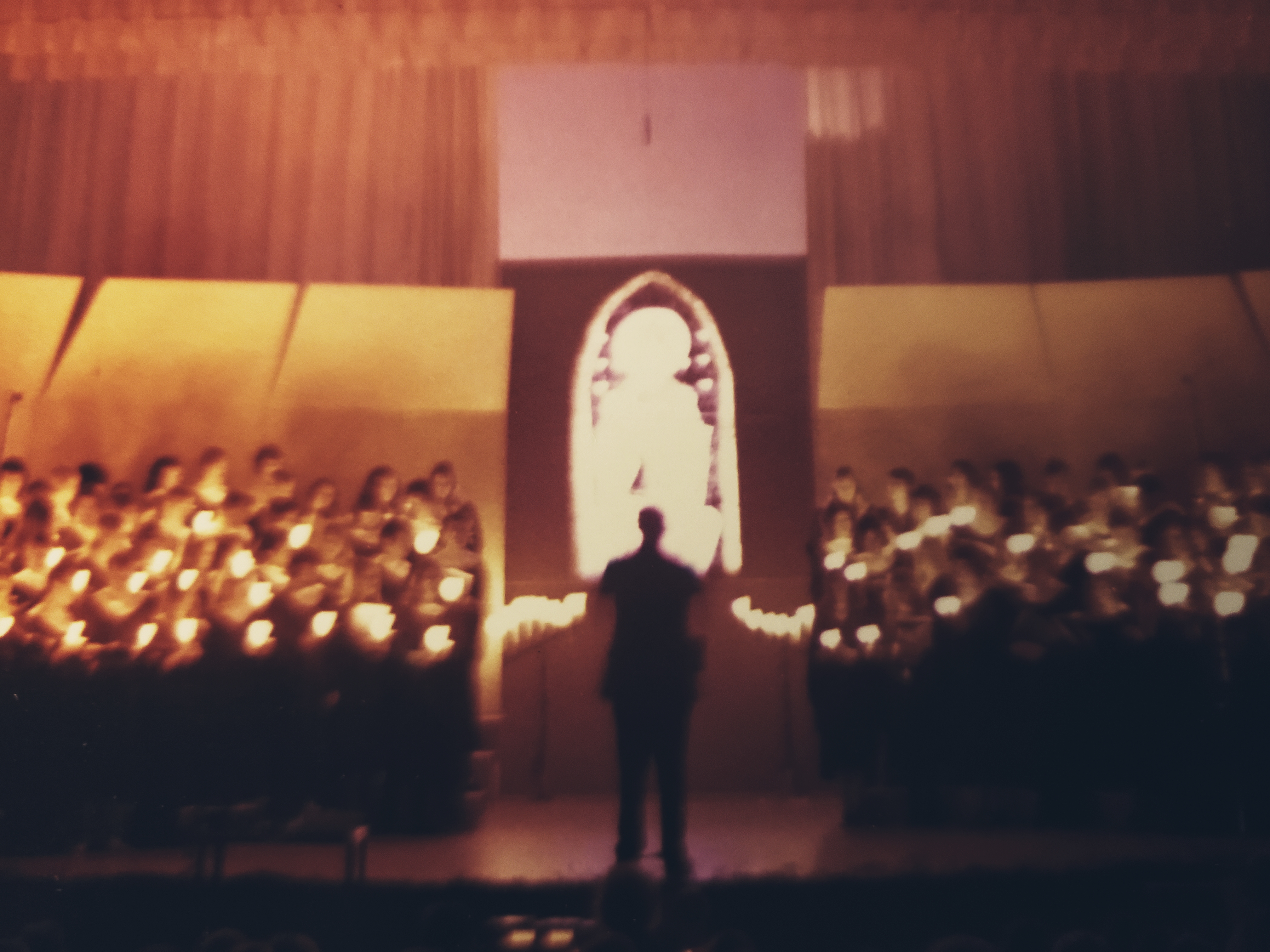
A most memorable tradition began soon after we had moved to Arkansas in the early 1970’s. My father had become the choral music director at (then) Arkansas Polytechnic College, a place that at the time was known for its band program but never had much of a choir. I suspect that he decided that he wanted to give a grand Christmas program one year. Preparations would always begin the Friday/Saturday before the concert with the search for the appropriate Christmas tree to cut and bring into the main lobby, the crafting of decorations, and last minute rehearsals. The program grew each following year and would begin with small ensembles singing in a pre-concert venue around a Christmas tree.

Antiphonal brass and choirs would perform from the open balconies of the music department lobby. Processional pieces that involved brass and organ announced the start of the program. Unique stage decorations such as large evergreen wreaths of cedar and pine or a mock stained-glass window would adorn the center of the stage.

There were exciting new choir pieces and familiar favorites and the community came out in droves year after year.

My father passed away a few months ago, and these memories have been a comfort these past few weeks. I am fortunate to have a soundtrack for my memories of him, and much of it is Christmas music. Here is a top five (ok, six) list of Christmas musical moments influenced by my Dad.

1. O Come all ye Faithful (Robert Shaw Chorale)
2. Come Dear Children – Alfred Burt
3. Ríu Ríu, Chíu – Anonymous
4. XIV: The March of the Three Kings, from Hodie by Ralph Vaughan Williams (really this entire work, Hodie, is worth a listen)
5. His Yoke is Easy, from Messiah by George Frideric Handel

And finally, a moment of sweetness that expresses my father’s love of music greater than any song, poem, or piece that I could have written.

What Sweeter Music – by John Rutter

I encourage each of you to embrace your traditions, not only during this season of the year, but all year. It might be baking or going to events. It might be meals together or a hike in the woods. It could be singing or storytelling. It could be volunteering to help others. Watch them grow each year. Make something your own tradition and share it with ones you love.

********

Images within this post are my own.