Tag Archives: Music

A little blues philosophy

It’s a part of the tune that doesn’t last long.

When I need a deep breath after things have gone wrong,

it’s a fishhook to bring me up from the depths. 

I find myself seeking a felicitous sound

and listening for the turnaround.

It’s a movement that’s made, whether in blues or in jazz

to keep a song interesting -some razzmatazz –

about one chords to sevens and other such stuff,

I won’t pretend to knowingly expound,

just listen for the turnaround.

It’s the first bud of spring coming out of the frost

and the very first lightnin’ bug of past summers lost,

It’s the yellow and red sneaking out of the green,

The first floating snowflake that lights on the ground

all transitions worthy of a turnaround.

The best we can do is to move on our own,

but walk among others so we won’t be alone.

It’s the time and the place of the new moon and stars,

As we are feet first. with our souls earthbound,

The last call will sound like a turnaround. 

When a song isn’t “just a song”

Music speaks to our inner being in many ways. Melody and rhythm can get our body moving, increase our pulse, or help us relax. Music with lyrics can do the same thing, but the added dimension of words with the music impacts our thoughts and feelings on a different level. What poetry does without music; song lyrics achieve in combination with it. It is much like poetry in this way, with music stated rather than implied. Countless stories exist about songs that opened doors for people or affected them in some way.

I like the Beatles. Their music and lyrics always provide me with a feeling or thought I didn’t have the last time. It is particularly uplifting to me. Others may feel differently, or other artists may provide that same feeling to them. Yet, for me – I always return to the Beatles for inspiration or comfort.

My parents have both recently passed away. My father in 2019, and my mother last December. Both parents wished to be cremated, so my brother, sister and I abided by their wishes. When my father passed, we made no arrangements to inter his ashes, as we had to quickly make plans to relocate my mother closer to me as a primary care giver. My Dad’s ashes traveled with us approximately 800 miles from their home and sat on my mother’s bedside table. My mother, despite my best efforts, did not take especially well to the relocation. Then the COVID pandemic interrupted our lives. Far from her “home”, she was not her happiest self and tended to sleep a lot. This continued after restrictions to visitation were lifted. Ultimately, she passed peacefully in her sleep, a manner that I am confident was her deepest desire.

We held a brief family-centered service so that the immediate family could all say their goodbyes. But after her cremation we were faced with what to do with her ashes and my father’s ashes. After a bit of reflection, I thought it would be a good idea to bring them back to the community that had been their home and inter them in the church that had been their extended family. I made contact with the church, and after several months of discussions, planning and delayed communications, we finally arranged a memorial and interment service for my parents. It is actually today, as I write this, in approximately 3 hours.

As I prepared to make the 800-mile drive from my house to our destination, I was going over the mental checklist, setting the GPS, and turned on the radio in my car. I often listen to a certain satellite radio service that carries “The Beatles Channel” (18). They have a regular feature entitled, “My Fab Four,” that features fans or other musicians, actors, etc. listing and deejaying their personal list of four favorite Beatles songs. This feature was just beginning, as I pulled out of my driveway onto my street. The featured deejay talked about the first song in his list being on the first Beatles album he had heard. The song was “Two of Us” from the Let it Be album.

Two of Us, by Paul McCartney/John Lennon

Two of us riding nowhere
Spending someone’s hard-earned pay
You and me, Sunday driving
Not arriving, on our way back home

We’re on our way home
We’re going home

Two of us sending postcards
Writing letters on my wall
You and me burning matches
Lifting latches, on our way back home

We’re on our way home
We’re going home

You and I have memories
Longer than the road
That stretches out ahead

Two of us wearing raincoats
Standing solo in the sun
You and me chasing paper
Getting nowhere
On our way back home

We’re on our way home
We’re going home

You and I have memories
Longer than the road
That stretches out ahead

Two of us wearing raincoats
Standing solo in the sun
You and me, chasing paper
Getting nowhere
On our way back home

We’re on our way home
We’re going home

We’re going home

You better believe it
Goodbye

The lyrics spoke to me in that moment. Two of us….On our way home…We’re going home. Now, granted this is The Beatles channel and chances are good that I would have heard the song sometime during the day. Yet, hearing it the MOMENT I left my house on a journey returning my parents to their resting place and their home. There was something otherworldly about it. Neither of my parents cared much for the Beatles, but they were musicians and understood the messages that music can convey. I believe that I was being spoken to by spiritual forces conveying their approval at what I was doing. Fast forward to the end of my trip. I stopped at a town 20 miles from my hotel destination to grab a fast-food dinner. I received my order at the drive-thru and was returning to the interstate – I switched on the radio to the Beatles Channel. “Two of Us” was just starting to play…again, the timing of that moment was simply supernatural.

Sometimes a song isn’t just a song. Sometimes it is a moment of revelation or confirmation. To me, this was as if my parents spoke to me, telling me this was what they wanted. They are home.

Music is the universal language of mankind. Henry Wadsworth Longfellow

Thanks for reading.
Once, in a blue moon

I see a full moon lighting up the road ahead, the sound of B.B. King’s blues are knocking in my head.

Behind me, morning peeks and skies tint gold, as I drive toward the night – it’s bright and bold.

Yesterday, I cleaned the leaves from my front yard, blowing up a cloud of amber shards.

Leaves of yellow, gold and brown and red, coated under foot and seeming dead.

Clearing out the old then seeing green, the grass looked more healthy than it’s ever been.

Everyday – as B.B. sings his full lament- I have the blues – but sadness isn’t what he meant.

There is beauty in this world of loss. What we carry through we layer or emboss

on the surface of our daily works of art. We make from aches and pain a stronger beating heart.

I’m still driving west to chase the moon, but daylight will arrive and overtake me soon.

And as the song from B.B. King is done, the opening picking strain of Here Comes the Sun.

Cantabile

America,

about this unfinished symphony…

The movements that proceeded this one are fading and the players are tired.

This current antiphonal fugue section isn’t working well. The swells grows louder and less melodious by the measure. Gone are the phrases that rise and fall in unison. In their place are resonant pedal tones, brassy glissandos and clashes of cymbal and blat. Largely single voices that raise the din.

Remember the sweeping melodies of the past. True, the ancient tunes of the indigenous are mostly lost, but they were here when the land was born and still echo in our ears if we just listen. Our young work of art holds the jigs of immigrants, the hymns of the pious and yes, the blues of the enslaved. Some songs were joyous, others dripped with pain and sadness. They may have been singular in their experience, but they are unifying in their impact.

Across the landscape, the gospel choir of sinners and saints and the choral moments of victory shouted that we shall have a song, and you gave us one.

Contemporary ditties dot the eras, but do not define the work. Populism accentuates the moment, but ad libitum cannot sustain the chords. Intervals from fourth to fifth and augmented sevenths resolve themselves to prime.

Anger and happiness are to be heard throughout, folded in as motifs – but it must lead to where it begins and ends, in one voice.

A voice shared of past and future songs, of freedom for all, ringing bells of prosperity for each one of us, crescendo in equality and building the next movement.

Cantabile.

Portamento

As if the sunrise welled and overflowed,
an inkling of light, then creation bestowed.
Anticipation moments pass
from intra-chordal throes,
at last to grounded melody in phrase.

Or let me express in other ways;
a passion builds in smaller plays.

First, the pedal points of tone suffice,
a basis for embracing life.
Like moon and stars and sunlight greet
the common ground beneath our feet.

Tunes of commonality composed
above this founding base suppose
synchronicity imbued,
and many intervals accrue.

Yet, with the suspense here to next
a lingered moment’s desired effect
mellifluous, and tasting sweet,
such to sweep you off your feet.

As memories are long and vast
our songs with portamento last.

What Sweeter Music

Traditions start as single activities.

A one time event makes an impression so that it is planned for again in order to recapture the excitement and joy of the first one. Nothing celebrates holidays like traditions.

I had the fortune of growing up in a musical family. Both my father and mother were music teachers and my two siblings and I had lives that were intrenched in music lessons, church choirs, band, piano, choir concerts, etc. No time of year was more filled with music than Christmastime.

At early ages, my sister and I would wear out the phonograph playing my father’s vinyl albums of the Robert Shaw Chorale “Hymns and Carols Vol. 1” and the Harry Simeone Chorale “The Little Drummer Boy.” I don’t remember the first time I heard them, I just remember listening to them every year. This grew into my own tradition of seeking out and purchasing a unique Christmas album each year. My collection on CD is extensive. 🙂

When we were slightly older, perhaps tweens or so, my parents taught us a Christmas carol to sing for our relatives after we made the long car trip to Grandmother’s house – in 4 part harmony. It kept us engaged and perhaps kept us from fighting over spots in the back seat. Our first carol was an arrangement of Deck the Halls, followed in subsequent years by several Alfred Burt Carols. It became a tradition throughout our teens, with my oldest brother contributing the final carol we would rehearse and perform as a family unit (written in a fit of inspiration during his first year of teaching and sent to my parents as a Christmas card – much like the Burt carols).

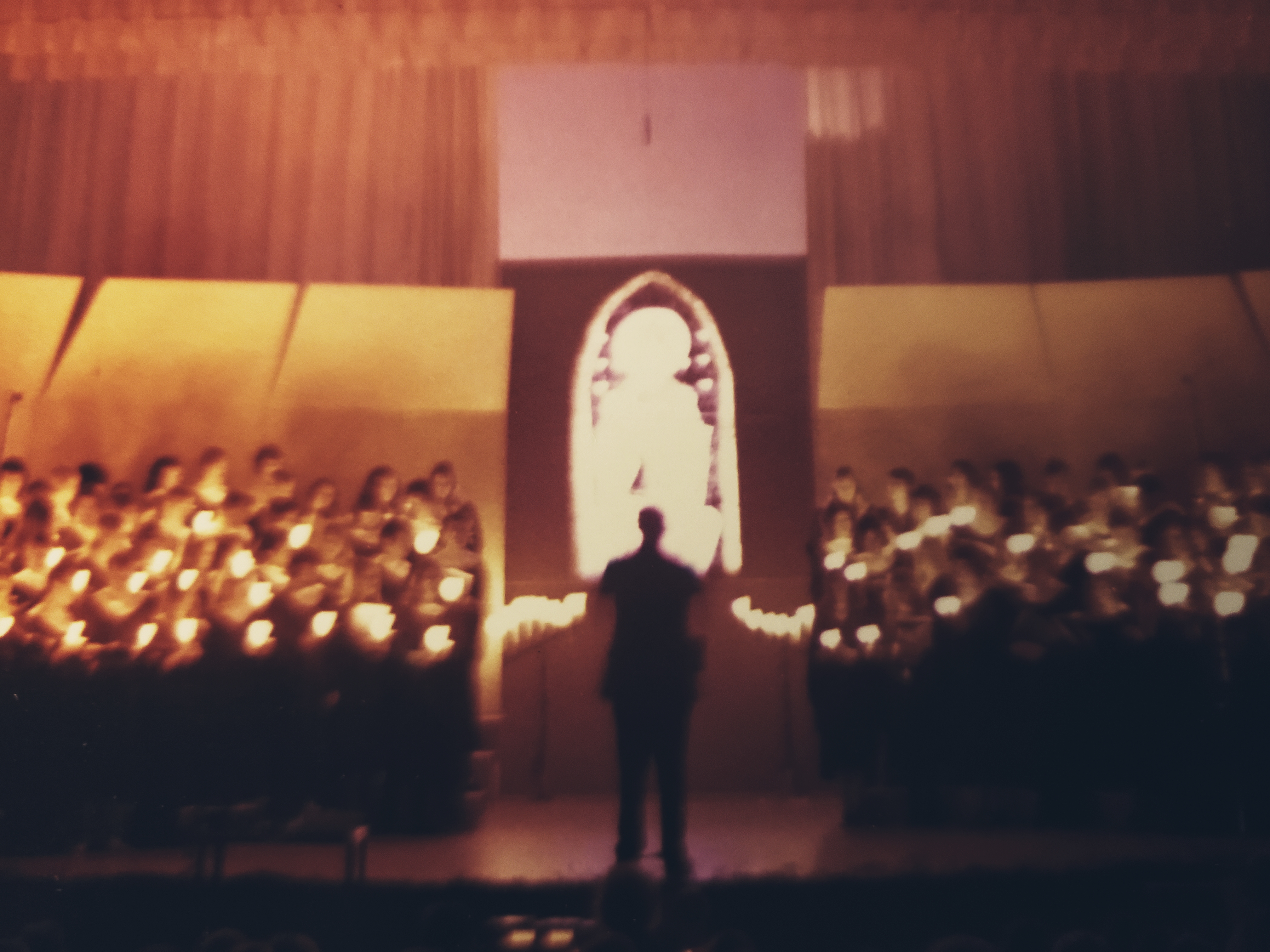
A most memorable tradition began soon after we had moved to Arkansas in the early 1970’s. My father had become the choral music director at (then) Arkansas Polytechnic College, a place that at the time was known for its band program but never had much of a choir. I suspect that he decided that he wanted to give a grand Christmas program one year. Preparations would always begin the Friday/Saturday before the concert with the search for the appropriate Christmas tree to cut and bring into the main lobby, the crafting of decorations, and last minute rehearsals. The program grew each following year and would begin with small ensembles singing in a pre-concert venue around a Christmas tree.

Antiphonal brass and choirs would perform from the open balconies of the music department lobby. Processional pieces that involved brass and organ announced the start of the program. Unique stage decorations such as large evergreen wreaths of cedar and pine or a mock stained-glass window would adorn the center of the stage.

There were exciting new choir pieces and familiar favorites and the community came out in droves year after year.

My father passed away a few months ago, and these memories have been a comfort these past few weeks. I am fortunate to have a soundtrack for my memories of him, and much of it is Christmas music. Here is a top five (ok, six) list of Christmas musical moments influenced by my Dad.

1. O Come all ye Faithful (Robert Shaw Chorale)
2. Come Dear Children – Alfred Burt
3. Ríu Ríu, Chíu – Anonymous
4. XIV: The March of the Three Kings, from Hodie by Ralph Vaughan Williams (really this entire work, Hodie, is worth a listen)
5. His Yoke is Easy, from Messiah by George Frideric Handel

And finally, a moment of sweetness that expresses my father’s love of music greater than any song, poem, or piece that I could have written.

What Sweeter Music – by John Rutter

I encourage each of you to embrace your traditions, not only during this season of the year, but all year. It might be baking or going to events. It might be meals together or a hike in the woods. It could be singing or storytelling. It could be volunteering to help others. Watch them grow each year. Make something your own tradition and share it with ones you love.

********

Images within this post are my own.

Dispatching the Doldrums

It is time to clear the cobwebs and write about anything.  Blog writing for me is  a way for me to exercise my creative skills and (bravely) share what I’m writing.  Every now and again, I like to share what I’m thinking/doing/reading/listening to/watching.

Watching

A week ago, I just finished watching Band of Brothers on Amazon, which was based on the book of similar name by Stephen E. Ambrose.   I  know I’m a little behind ( it first aired on HBO in 2001).  But, I didn’t subscribe to HBO then, and never invested in DVDs of the miniseries.  Wow.  An incredibly well-done set of vignettes from the history of Easy Company of the 101st Airborne during WWII in Europe.  It was produced by Steven Spielberg and Tom Hanks – it has much the same feel as Saving Private Ryan.  Each episode centers around a different event and focuses on a different character’s perspective.  My favorite episode involved the Battle of Bastogne, and told the story from the perspective of Doc Roe, the company’s medic.  He displayed courage and a singular ability to keep going in bone chilling cold under relentless bombardment, while keeping the men is his company in fighting shape and providing care to the wounded.  The scenes are graphic and the emotion is raw.  The miniseries drives home the point, that in war- there is no rest.  Even when you think you may get a weekend leave, something happens to call the company back into the fray.  After battles, you move on to the next line.

Reading

I’ve mentioned before that I’m a slow reader and one who is prone to start multiple books to find one that captures my interest.  Right now, I think have five books in various stages of reading.  Most recently, I started reading Dispatches from Pluto: Lost and Found in the Mississippi Delta, by Richard Grant. It is a true tale, a collection of tales actually, of a British travel writer (Grant) and his girlfriend after they decide to buy an old plantation home in heart of the Mississippi Delta.  Stories of Southern tradition, along with the tenuous combination of gentility, race and class, are told without judgement – but with a keen perception of the relationships involved.  This book is a great look into this forgotten region of the country.  Truth be told – I am related to people who grew up in this area of Mississippi, and am very familiar with the themes of this book.  The Delta is a both a wasteland and a land of riches.

Listening

I have eclectic music tastes.  I will listen to almost any genre, depending on my mood and as long as it is well done.  In recent years, I have become interested in Americana/folk styles.  I like the realness of it and how it can impact you emotionally.  With that in mind, I want to recommend music by a friend.  I met Mark Currey in high school, when we both attended a Gifted/Talented Summer Camp.  We were in the choral program, and were introduced to many different genres of music in the program.  We were encouraged to be creative in our free time, and it was obvious that Mark was a songwriter even then. I wrote in my journal in my free time- ain’t life funny.  We weren’t best friends, but we got along well. After that summer, we parted ways (like most everyone does), only to reconnect many years later via FaceBook.  I found out he had recorded an album, his first, in 2017.  The classic story of the Late Bloomer – I can relate.  His record, Tarrant County, is part Country, part Americana – and I encourage you to give it a listen. Mark has a very warm vocal style (he’s a tenor), and his lyrics are real storytelling.  You can download it at the either of the links above, or you can find it on streaming services.   There are some really nice musical moments, some thought provoking lyrics, but never overdone.  You might find something you like.

Thanks for reading.

***


A Cappella Friday: Choose Something Like a Star

A cappella music (without instrumental accompaniment) is particularly enjoyable for me to listen to. As a poet (and an avocational musician), I am drawn to the similarities that poems and a cappella music have. Lyrical phrasing, meter, rhyming, and onomatopoeia mean so much to a cappella music, because it relies so heavily on the human vocal element.
**************************************

Anyone that has followed me since my origins here with Taps and Ratamacues may recall this as a semiweekly feature for a while, but I haven’t written about specific music/poetry combinations in quite some time. Again, as in other entries, this is not an a cappella piece specifically, but the positive interaction of music with poetry is undeniable.

This entry came about as a result of phone conversation with my mother and father, both life-long musicians – now retired. They both have an impeccable memory for musical anecdotes.

We were discussing the word taciturn, as it described a friend of theirs going through rough time, to which my father said the only other place he ever recalled hearing that word was in a choral setting of Robert Frost’s poem, Choose Something Like a Star.

My curiosity was peaked, and I went searching.

Frost wrote the poem in 1916. It is a remarkable piece that addresses humankind’s need for reassurance from a greater being.  It contains elements of philosophy, religion, and science – the trifecta of sought meaning.  It is one of Frost’s more direct and driven poems.  We seek meaning in life, and can choose things to convey that meaning. We expect these icons to give us direction and explanation.  “To be wholly taciturn is not allowed.”

Frost’s point was that in choosing “something like a star”, something distant and far off, we can be comforted in the fact that it exists and “it burns” despite our desire for clear explanation.

Randall Thompson (1899-1994) wrote a collection of songs using Frost poems as lyrics, entitled Frostiana (Seven Country Songs). In 1959 Thompson was commissioned to write a piece commemorating the bicentennial of the town of Amherst, Massachusetts. It was decided that the piece should include lyrics comprised of Robert Frost’s poetry, as he had lived in Amherst for a number of years. The town originally lobbied for The Gift Outright, which Frost later recited at JFK’s inauguration.  Not believing that poem to be appropriate for this occasion, Thompson gained permission to select poems himself.  He eventually  chose seven texts – including the well-known poems The Road not Taken and Stopping by Woods on a Snowy Evening.  Also chosen was the poem Choose Something Like a Star.

The vocal arrangement starts ethereally, with sopranos singing the ‘O star’ phrasing as if it is a far away object and the other voices of the choir building in the harmony – pushing outward to meet this fairest object in sight.  Thompson is masterful in his use of chord structure and phrasing with Frost’s poem.  There is tension in the unanswered questions, there is calm in the resolution.

Frost and Thompson knew each other and held great mutual respect for each man’s work.  Frost was in attendance at the premiere performance of Frostiana, and was so delighted by the performance that, at the conclusion of the piece, he stood up and shouted, “Sing that again!” In fact, he was so impressed by the composition that he banned any other composers from setting his poems to music.

We seek meaning in the universe, and often we can find it in the beauty and unexplainable mystery of existence itself.

Pattern

Going forth from dot to dot,
and lines to sect, and textured plat
– I feel her form in jazz – all that
time, melodious tone and scat.

And though the curve she’s wont and apt
to slide and clutch, her eye for voicing
taut and slack.

The tremble that I feel is naught
set side by side her ending thought.
And once the silence lingers hot,
Is she the pattern that I seek, dare not?

Thoughts on epiphany

I have decided that music
bears witness to the scenery around us.

A woman wearing a bunny eared winter cap
can listen to “Wild Thing” and “Always a Woman”
and still be focused on serious world issues.

The sounds of Professor Longhair and Dr. John
refresh a winter day of Epiphany just as well as Kings College
at Christmastide.

A conversation with a beautiful soul
can ignite a fire – for warming a dulled
and calloused heart.

Walking on salted sidewalks
leaves a rhythmic pulse in your brain
with bodhran and guiro contributions.

The sparkle of lights in the darkness
of early morning never grows old. The silence
makes them shine.

The end of the day lingers when you drag out
the last light from inside.