Category Archives: prose

Adventures in Productivity

Early Sunday morning, I awoke with the idea that I wanted to make a loaf of sourdough bread. I received a breadmaker from my son as a Christmas gift. I have enjoyed making bread “the old fashioned way” for many years, and entertained the idea of a breadmaker because, well, I like bread, and sometimes there is not enough time to mix ingredients, let it rise, divide the dough, let it rise again, and cook it. I will do it that way for holiday bread, but it is time consuming.

Scrounging around the kitchen at 7 AM, I realized that I did not have enough all-purpose flour to complete the recipe. What I did have was whole wheat flour. I have never heard of whole wheat sourdough bread…so I went to my computer to google search.

My internet connect was dead.

We have a funky wireless connection at our house. It drops out my wife’s laptop most of the time, but rarely does my computer lose the signal. I rebooted the modem…nothing. I rebooted my computer….still nothing.

The definition of insanity is, doing the same thing over and over and expecting a different result.

I rebooted everything again…just in case. No luck.

Then I took an ethernet cable and hooked my computer directly to the modem…good,

then to my wireless router…bad.
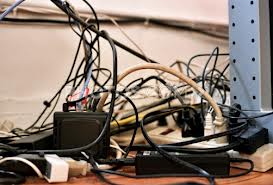
tangled wires

I am fortunate to have purchased a spare router^, so I powered everything down, replaced the router, plugged everything in, powered it up and …..BAM….

working internet.

Amazing.

A little searching for bread recipes and I found the following:

A hearty whole wheat yeast bread with the tangy flavor of sourdough. This recipe was written for use with bread machines.

Sourdough Whole Wheat BreadFor 1 1/2 Pound Loaf:
3/4 cup plus 2 tablespoons water
2 tablespoons vegetable oil
1 cup sourdough starter (room temperature)
1 1/2 teaspoons salt
1 tablespoon granulated sugar
3 cups whole wheat bread flour
2 teaspoons active dry yeast

I loaded the ingredients in the breadmaker, plugged it in and pressed start.

Three and a half hours later, we enjoyed a warm loaf of whole wheat sourdough bread with lunch. It did not have an extra heel, but we were joyful nonetheless.

bread
********************************

Why does this matter?

I have been reading Steven Johnson’s book, Where Good Ideas Come From: The Natural History of Innovation. It is one of the five or six books (paper and electronic) that I have cracked open at the moment^^. He discusses the coral reef as a model for technology development – filling the needs required by those in the environment so they don’t have to reinvent something from scratch to fill their need.

Adaptation to the situation via the adjacent possible.

To make a loaf a bread required not only the ingredients (whether I could use whole wheat flour or not), the knowledge of how to mix them and cook the loaf, the technology of a bread machine, how to troubleshoot an internet connection, performing a search of information out in cyberspace…you see where this is going right?

Steven Johnson’s point is that we don’t have to know how all of these things work, but simply how to use them. That opens up the adjacent possible…If I use it there, maybe I can use it here.

That is how new ideas are born.

Trying the bread with a little margarine and apple butter is my next big idea.

*********************************

^We purchased a certain provider’s bundled internet and phone package a few years ago, only to find out recently, when our phone connection went out, they no longer support the equipment…so we have to do that on our own. I found what we needed and we purchased a few of them.

^^Yes, I can’t seem to finish a book without starting another. I won’t apologize for that any longer.
a cappella Friday: Madrigals

A cappella music (without instrumental accompaniment) is particularly enjoyable for me to listen to. As a poet (and an avocational musician), I am drawn to the similarities that poems and a cappella music have. Lyrical phrasing, meter, rhyming, and onomatopoeia mean so much to a cappella music, because it relies so heavily on the human vocal element.

*******************************
Yes, I know it is not Friday, but I’ve been working on this idea for a while, inspiration struck, and who am I to argue with the Muse.

A madrigal, it seems, has several definitions.
1. It is short poem, from Medieval times, often about love, and suitable for being set to music.
2. It is a song for two or three unaccompanied voices, developed in Italy in the late 13th and early 14th centuries.
3. It is a polyphonic song using a vernacular text and written for four to six voices, developed in Italy in the 16th century and popular in England in the 16th and early 17th centuries.

Having sung in small groups in my younger years, I remember many of these songs. They had terrific harmonies, moving lines. I never really thought of the lyrics then, but all of these were musical settings of poems. The arguments of poetic forms still occuring then, apparently.

O, that the learned poets of this time
who in a lovesick line so well can speak,
would not consume good wit in hateful rhyme,
but with deep care some better subject find.
For if their music please in earthly things,
how would it sound if strung with heav’nly strings?

The song was published in Orlando Gibbons’s First Set of Madrigals and Motets of 5 parts (1612). A snippet of a recording can be found here, or you can do a search on Spotify or some other internet music source.

Perhaps his best known madrigal is The Silver Swan. A beautiful recording is given here.

The silver Swan, who, living, had no Note,
when Death approached, unlocked her silent throat.
Leaning her breast upon the reedy shore,
thus sang her first and last, and sang no more:
“Farewell, all joys! O Death, come close mine eyes!
More Geese than Swans now live, more Fools than Wise.”

FRANCESCO PETRARCA, 1304-74, better known as just “Petrarch” provided a large trove of the Italian madrigal lyrics. His Canzoniere is a collection of love songs and sonnets. His sonnets are largely credited with saving the form from obscurity. There is a great deal of information about his Muse Laura, and the origins of his poetry.

Early madrigal music dates back to 14th century Italy as a developed two- or three-line verse supported by identical music. Over time, Italian madrigals were recognized as the beginning of “word painting,” the combining of text and music to create a feeling.

*At this time I can’t find an internet recording of the following madrigal to share, but the words in Italian alone are worthy of a read.

Come talora al caldo tempo sòle
semplicetta farfalla al lume avezza
volar negli occhi altrui per sua vaghezza,
onde aven ch’ella more, altri si dole:

cosí sempre io corro al fatal mio sole
degli occhi onde mi vèn tanta dolcezza
che ‘l fren de la ragion Amor non prezza,
e chi discerne è vinto da chi vòle.

E veggio ben quant’elli a schivo m’ànno,
e so ch’i’ ne morrò veracemente,
ché mia vertú non pò contra l’affanno;

ma sí m’abbaglia Amor soavemente,
ch’i’ piango l’altrui noia, et no ‘l mio danno;
et cieca al suo morir l’alma consente.

The Italian is beautiful just in sound alone (it is a Romance language, after all), the English translation (courtesy of http://petrarch.petersadlon.com/canzoniere.html?poem=141) goes like this…

As at times in hot sunny weather
a guileless butterfly accustomed to the light,
flies in its wanderings into someone’s face,
causing it to die, and the other to weep:

so I am always running towards the sunlight of her eyes,
fatal to me, from which so much sweetness comes
that Love takes no heed of the reins of reason:
and he who discerns them is conquered by his desire.

And truly I see how much disdain they have for me,
and I know I am certain to die of them,
since my strength cannot counter the pain:

but Love dazzles me so sweetly,
that I weep for the other’s annoyance, not my hurt:
and my soul consents blindly to its death.

The form evolved over the years and by the 16th century consisted of a refined four to six parts, offering twelve lines of lyric verse with love, desire, humor, satire, politics, or pastoral scenes as the theme. Gibbons and Sir Thomas Morley (1557-1602) are among the more prolific writer/composers of the period.

My bonnie Lass she smileth

When she my heart beguileth. Fa la. . . . .
Smile less, dear love, therefore
And you shall love me more. Fa la. . . . .
When she her sweet eye turneth
O how my heart it burneth! Fa la. . . . .
Dear love, call in their light,
Or else you’ll burn me quite! Fa la. . . .

Finally, the madrigal has been parodied, quite successfully

Peter Schickele (PDQ Bach) penned “My Bonnie Lass, She Smelleth” as a parody of Morley’s “My Bonnie Lass She Smileth”

My bonnie lass, she smelleth,
Making the flowers Jealouth.
Fa la la (etc.)

My bonnie lass dismayeth
Me; all that she doth say ith:
Fa la la (etc.)

My bonnie lass; she looketh like a jewel
And soundeth like a mule.
My bonnie lass; she walketh like a doe
And talketh like a crow.
Fa la la (etc.)

My bonnie lass liketh to dance a lot;
She’s Guinevere and I’m Sir Lancelot.
Fa la la (etc.)

My bonnie lass I need not flatter;
What she doth not have doth not matter.
Oo la la (etc.)

My bonnie lass would be nice,
Yea, even at twice the price.
Fa la la (etc.)

Singing Hey Nonny Nonny Nonny No.

Bells

bellsThings I’ve done in the last 48 hours.

– Baked 6 loaves of special holiday whole wheat bread, with cinnamon and brown sugar*.
– Delivered 4 loaves of the aforementioned bread as gifts to friends
– Ate 3/4 of 1 loaf of the aforementioned, remaining bread
– Searched TV menu for decent Christmas programs, finding none.
– Watched 1/3 of each of the LOTR movies
– Finished Christmas shopping for 6 gift cards, 1 bracelet, 2 sweaters, 6 bottles of shampoo/lotion that I can’t smell, and 2 or 3 things that were bought that I’m not sure what happened to them.
– Drank 1 bottle of Magic Hat #9
– Bought 2 large packs of AA batteries
– Watched the final 2 minutes of 2 different NFL games
– Washed 3 loads of my son’s college laundry to get it out of the floor
– Listened to 1/9th of my 9 hour Spotify Christmas playlist
– Played ukelele for 5 minutes
– Assembled 1 rolling rack
– Ventured out twice to the local megamart after I specifically stated that I wanted my errands completed early, so I would have to experience the last minute madness…yet I forgot 2 things…at 2 different times.
– Pondered how to write a 1 Christmas post that could accomodate my desire to recognize one of my favorite carols/poems.
– Wrote the following sentence – Henry Wadsworth Longellow wrote a poem in 1863, entitled “Christmas Bells.”

It was written on Christmas Day 1863, likely as a result of the news that Longfellow’s son Charles had been wounded in Civil War action earlier that year…and the recent loss of his wife Frances. There is just a snippet below. I encourage you to search out the poem and read all of it. It is short by Longfellow’s epic lyrical poem standards**.

I heard the bells on Christmas Day
Their old, familiar carols play,
and mild and sweet
The words repeat
Of peace on earth, good-will to men!

It has been set to music twice. In 1878, the English organist, John Baptiste Calkin, used the poem with a melody he previously used as early as 1848. The more familiar version was set to music in the 1950’s by Johnny Marks (he of Rudolph the Red-nosed Reindeer fame). I’m partial to the Bing Crosby recording. However, google the recent recording by The Civil Wars, which is very inspiring, and in light of the poem’s origins, somewhat “poetic.”

Wishing you all a Happy Christmas.

********************
*A recipe handed down in the oral tradition from my father to me. Though it has origins in the Better Homes and Gardens cookbook.
**Pun intended

Travel: Catch as Ketchikan

This summer, my wife and I took the best. vacation. ever.

I’ve always wanted to go to Alaska. It ranked up there with Ireland, Maine, Switzerland…you get the idea. I am smitten with vast wilderness, mountains and fields of green and rock.


We took an Alaskan Cruise, which I highly recommend if you are looking for vacation ideas. Along with my parents (who had done the Alaskan cruise before) and my brother and his wife, we set sail from Seattle to head up the Inside Passage of the Alaskan Panhandle. A beautiful setting that words and even pictures don’t do justice. It is 360 degrees of wilderness. Pristine. (And so much more than I can describe in one post)

Our first stop on the cruise, after one day “at sea” was the town of Ketchikan. Our ship docked and we disembarked to explore.

Did you know that Ketchikan gets an average of 162 inches of rainfall a year? That’s an average of 13.5 feet. Yes…It was raining.

Climate is just one of the things that I think Alaskans just accept and deal with. The people we met seemed to be very satisfied with their pace of life and adapting to the challenges that Alaska offers.

After helping my father find an eyeglass nosepiece repair kit… Note to tourist areas…Let some brand name pharmacy set up shop in your area, so that people don’t have to walk a mile and enter every little tourist shop and ask if they have [fill in the blank]. Now, I know they WANT you to go into every little shop. But if you are looking for something specific then it might be more beneficial to have an obvious drug store and people wouldn’t get frustrated… I set off exploring.

I’m not a shopping kind of person, so I wanted to avoid the tourist trap souvenier places. I walked past the jewelry and tee-shirt shops…all of them bustling with activity… into the town.

Up a hill and stone’s throw from the Episcopal Church, I discovered the Ketchikan Public Library and City Museum.

Did I mention that it was raining?

I decided to visit. The library was closed. I’m not sure why, it was a Monday morning. But the museum was open. I like finding little known haunts like local bookstores, museums, and restaraunts .

And, I like to stay dry…so,

I contributed my donation to the city of Ketchikan, and stepped into the history of the town.

The flow of the room went counter-clockwise, starting with various native artifacts of the Tlingit people, natives of the area. Small totems and various toys and tools carved from wood and whalebone. Native people are such experts at using available resources, and their attention to detail is amazing.

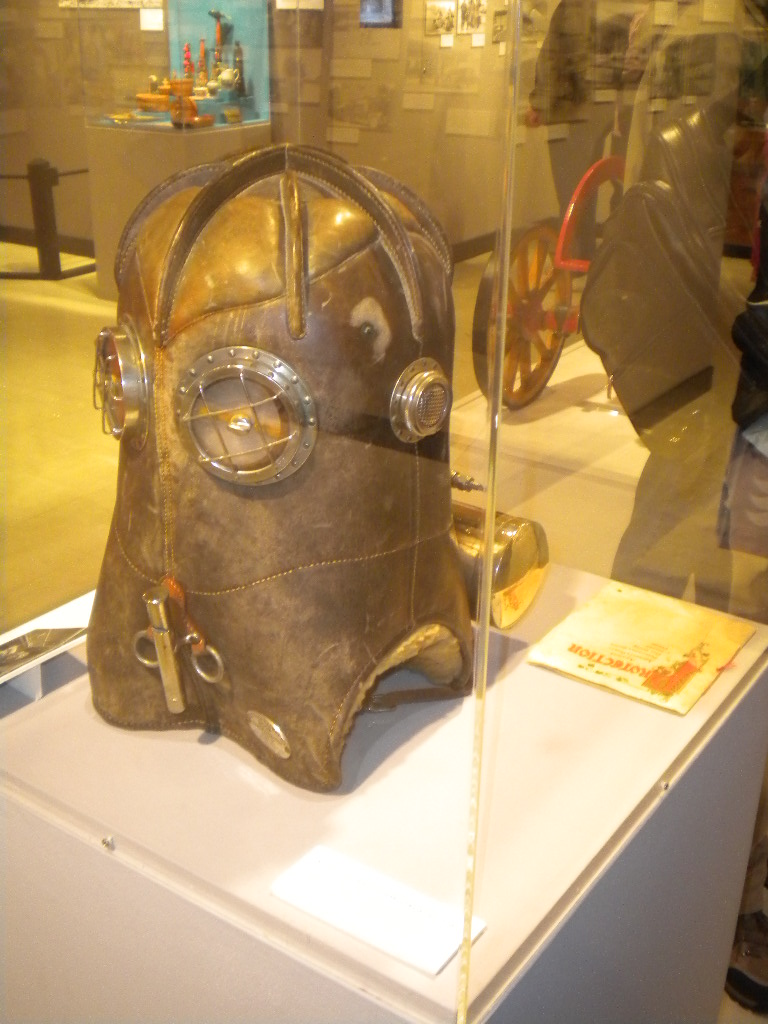
There were also items from the early pioneer settlers of the area and mementos from the heyday of the salmon fishing industry. Like this awesome gas mask to protect workers from the ammonia that was used in cold storage facilities.

I was fascinated by the pictures on the wall. The photo shown here, conveyed a baseball game played in 1912.  Because space was at a premium, they played games in the creek bed tide flats when the tide was out. The game would be called when the outfielders’ shoes got wet.

This, to me, was descriptive of the spirit of the settlers in Ketchikan.

Making things work.   Adapting.

Catch-as-catch-can.

A Cappella Friday: Walking

A cappella music (without instrumental accompaniment) is particularly enjoyable for me to listen to. As a poet (and an avocational musician), I am drawn to the similarities that poems and a cappella music have. Lyrical phrasing, meter, rhyming, and onomatopoeia mean so much to a cappella music, because it relies so heavily on the human vocal element.

****************************

I woke up this morning with a song in my head that I hadn’t thought about in quite some time. This song is not an unusual one…if you are familiar with hymns, you’d probably say that you’ve heard this one countless times in church.^ In the Garden (And he walks with me) is a gospel song written by American songwriter Charles Austin Miles (1868 – 1946), a former pharmacist who served as editor and manager at Hall-Mack publishers for 37 years. The story goes that he wrote it in the winter of 1912, after sitting for a time in his basement, with no windows, meditating on a scripture passage…(John 20:1-18). The subject is Mary Magdalene, coming upon the tomb of Jesus on the third day after his crucifixion. Miles was inspired by this event, and wrote the following poem.

In the Garden
I come to the garden alone,
While the dew is still on the roses,
And the voice I hear falling on my ear
The Son of God discloses.

Refrain:
And He walks with me, and He talks with me,
And He tells me I am His own;
And the joy we share as we tarry there,
None other has ever known.

He speaks, and the sound of His voice
Is so sweet the birds hush their singing,
And the melody that He gave to me
Within my heart is ringing.

Refrain

I’d stay in the garden with Him,
Though the night around me be falling,
But He bids me go; through the voice of woe
His voice to me is calling.

Refrain:
And He walks with me, and He talks with me,
And He tells me I am His own;
And the joy we share as we tarry there,
None other has ever known.

Yes, this IS a poem. Miles set it to music later that same day and it went on to become one of the best known hymns of the era. It has been covered by Elvis, Tennessee Ernie Ford, Ella Fitzgerald, Johnny Cash, and The Charlie Daniels Band.^^

Look at the rhyme scheme (a b c b). Check out the meter…if you know the hymn well, you can’t stop from swaying with the sing-song scansion in this. Further, the imagery of the garden over an entire day is there…dew on the roses, birds hush their singing, the night is falling. I feel the joy in the words, no music needed.

But…

I’ve a got a version of this poem/song that always improves my mood.

The group Acappella is an ongoing part of the ministry http://acappella.org/blog/ . The group has been in existence since the mid-eighties. They’ve had a number of personnel changes over the years. The version of In the Garden was part of a 1994 album, Hymns for all the World. This is not your grandmother’s gospel version. Check out the “walking” bass line throughout this recording, a very cool thing to add to this song, given the lyrics.

Give it a listen. You won’t be sorry.
This is a great musical setting for the poem, and the music serves a purpose to refresh the words.

See what I mean?

****************************

^ I’m certain of my reasons for thinking of this song and the particular version on the video is my “go-to” version. Let’s just say I’ve had a lot on my mind lately, and I have faith that things beyond my control can be taken care of…Without preaching…we’ll leave it at that.

^^ I know, I was surprised too.

Poet in Mind: John Clare

John Clare*, the Northamptonshire peasant poet was born on July 13, 1793. This is remarkable, because last Friday (July 13th), I was considering a Poet in Mind post, and thought of John Clare, whom I had discovered quite by accident several years ago. I was perusing the stacks of my library’s poetry section, something I enjoy because I discover new things, and I saw a collection of John Clare poetry. Out of curiosity, I checked it out and was not sorry for it.

John Clare was born into an illiterate farming family. He did receive some formal schooling, probably enough to function in a class-oriented society. He worked as a farm labourer to earn money. The fact that much of his poetry focuses on the natural world leads me to think he probably wrote much of his poetry in his head while watching nature in the fields he worked. He was also of the Romantic style.

Summer
By John Clare

Come we to the summer, to the summer we will come,
For the woods are full of bluebells and the hedges full of bloom,
And the crow is on the oak a-building of her nest,
And love is burning diamonds in my true lover’s breast;
She sits beneath the whitethorn a-plaiting of her hair,
And I will to my true lover with a fond request repair;
I will look upon her face, I will in her beauty rest,
And lay my aching weariness upon her lovely breast.

The clock-a-clay is creeping on the open bloom of May,
The merry bee is trampling the pinky threads all day,
And the chaffinch it is brooding on its grey mossy nest
In the whitethorn bush where I will lean upon my lover’s breast;
I’ll lean upon her breast and I’ll whisper in her ear
That I cannot get a wink o’sleep for thinking of my dear;
I hunger at my meat and I daily fade away
Like the hedge rose that is broken in the heat of the day.

The Romantic style can be summed up as “the spontaneous overflow of powerful feelings”**, with the additional work and “pain” of using strict meter and form. It’s not easy expressing your emotions in such structural forms, and the Romantic Movement recognized that as a means to develop “good” poetry.

Trial by fire, as it were.

John Clare was always a lesser known poet, perhaps because of his humble background. He actually did publish during his lifetime, though he could not make a living as a poet. He had to continue with a variety of manual labor jobs to support his wife and family. It was a struggle that contributed to poor health, heavy drinking and bouts of depression. However, he wrote rather prolifically. About love and nature, Rural life, his passions***, animals, birds, insects.

First Love
By John Clare
I ne’er was struck before that hour
With love so sudden and so sweet,
Her face it bloomed like a sweet flower
And stole my heart away complete.
My face turned pale as deadly pale,
My legs refused to walk away,
And when she looked, what could I ail?
My life and all seemed turned to clay.

And then my blood rushed to my face
And took my eyesight quite away,
The trees and bushes round the place
Seemed midnight at noonday.
I could not see a single thing,
Words from my eyes did start—
They spoke as chords do from the string,
And blood burnt round my heart.

Are flowers the winter’s choice?
Is love’s bed always snow?
She seemed to hear my silent voice,
Not love’s appeals to know.
I never saw so sweet a face
As that I stood before.
My heart has left its dwelling-place
And can return no more.

His depression and declining mental health eventually led him to admitting himself to an asylum where he primarily lived the last 27 years of his life. After his death in 1864, his poetry languished for the remainder of the 19th century, but Clare’s poetry was rediscovered in the late 20th century, and he was recognized for his keen descriptions of nature, the rural English countryside, and his dedicated practice of the Romantic style.

There is a John Clare Society
Several of his collections are posted online at John Clare Info.

To close, I selected two poems that juxtapose different views of hope. Both demonstrate the power of poetry, the struggles that we face, and how we can meet the challenges.

TO HOPE.
By John Clare

AH, smiling cherub! cheating Hope, adieu!

No more I’ll listen to your pleasing themes;

No more your flattering scenes with joy renew,

For ah, I’ve found them all delusive dreams:

Yes, mere delusions all; therefore, adieu!

No more shall you this aching heart beguile;

No more your fleeting joys will I pursue,

That mock’d my sorrows when they seem’d to smile,

And flatter’d tales that never will be true:

Tales, only told to aggravate distress

And make me at my fate the more repine,

By whispering joys I never can possess,

And painting scenes that never can be mine.

THE INSTINCT OF HOPE
By John Clare
Is there another world for this frail dust
To warm with life and be itself again?
Something about me daily speaks there must,
And why should instinct nourish hopes in vain?
‘Tis nature’s prophesy that such will be,
And everything seems struggling to explain
The close sealed volume of its mystery.
Time wandering onward keeps its usual pace
As seeming anxious of eternity,
To meet that calm and find a resting place.
E’en the small violet feels a future power
And waits each year renewing blooms to bring,
And surely man is no inferior flower
To die unworthy of a second spring?

*John Clare image by Edward Scriven, after William Hilton
stipple engraving, published 1821
NPG D5221
© National Portrait Gallery, London

**William Wordsworth. He knew a thing or two about Romantic poetry.

***He had a lifelong crush on his first love, Mary Joyce. She is a frequent subject of his love poetry, and obviously his muse. He was never allowed to court her formally, because they were of different classes in society. He continued to write about her throughout his life, and was apparently devastated to learn of her death in 1838. This is supposed to have contributed to his depression and eventual self-imposed admission to an asylum.

Crafting Memories

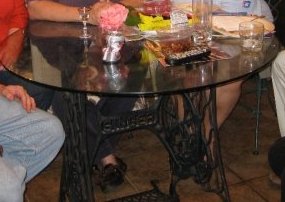
At my parent’s house, my mother has a glass topped table in her kitchen. The table base is the wrought-iron base of an old sewing machine…it has a pedal. It is only natural to want to push the pedal and make the wheel rotate. For years, members of the family have taken turns sitting in the seat with the pedal at our feet, cranking away while we drank coffee in the mornings, ate our breakfast, held late night discussions… sowing conversation and weaving stories. Our children, from the moment they could reach the pedal from the seat, wanted to sit there and work the pedal. It was a moment we could engage them in a conversation. But more than that, it was a time to share our memories with them.

…until the axle finally broke away from the wheel. We could rest our feet there, but the pedal would not move. It was as if time conspired. Everyone was older, people were moving faster, things break down.

During one of his recent visits, my nephew attached the axle to the wheel and wrapped it with rubber bands. He is ten years old. He understands the value of memories and wanted to fix it.

We noticed it this past Thanksgiving and pedaled again with joy.

Rubber bands don’t last forever either, and they will in time dry out and become frangible. Those attachments, unless welded or firmly adhered, will become loose and broken again.

Time can take its toll on things, but memories fashioned with craftsmanship and ingenuity will last.

Our children see to that.

Now comes the part where…

We all make lists.

I like lists because they 1) help me remember things and 2) I have a sense of accomplishment when I can mark something off the list. This is particularly true with activities and goals. I like seeing a piece of paper with lines through items.

So with the new year rapidly approaching, I thought that I would put a list here on the blog…not that I have a tremendous following that cares. It seems like a natural place to put stuff like that.

Things I want to do better in 2012
So here goes…
1. Read more books, one at a time – I am a bad parallel reader. I try to read too many things at once. It doesn’t work. Best thing ever – Books on Audio for commutes.
2. Get more exercise – Yeah I know, this is used every year and I give up the ghost every March or so. Consistent, paced activity…that’s all I’m shooting for this year. I want to be healthy, shouldn’t you?
3. Make more money – I know that sounds materialistic. Be real, we all want that, especially in this era of poorly performing stock funds. Actually, I want to be a better steward of what I have been blessed to receive. In that way, it would seem like I am making more money.
4. Have some more poetry published – I do write because I enjoy it, but everyone craves acceptance. I’ve had one item published online (see links), and I’ve been notified that a couple of other poems will be also published online during the first few months of 2012. Stay tuned for more information.
5. Come up with a 10 year plan – I’m approaching what should be the twilight years of my career and I want to have more goals in my back pocket. New interests, travel, any ideas?

What about you? You hearty few who might stumble upon or follow this blog…:)

What are your goals? How do you feel about lists?

Happy New Year to you. I wish you the best in 2012. Work hard, have fun, and be safe.

John