Category Archives: knowledge

a cappella Friday: Madrigals

A cappella music (without instrumental accompaniment) is particularly enjoyable for me to listen to. As a poet (and an avocational musician), I am drawn to the similarities that poems and a cappella music have. Lyrical phrasing, meter, rhyming, and onomatopoeia mean so much to a cappella music, because it relies so heavily on the human vocal element.

*******************************
Yes, I know it is not Friday, but I’ve been working on this idea for a while, inspiration struck, and who am I to argue with the Muse.

A madrigal, it seems, has several definitions.
1. It is short poem, from Medieval times, often about love, and suitable for being set to music.
2. It is a song for two or three unaccompanied voices, developed in Italy in the late 13th and early 14th centuries.
3. It is a polyphonic song using a vernacular text and written for four to six voices, developed in Italy in the 16th century and popular in England in the 16th and early 17th centuries.

Having sung in small groups in my younger years, I remember many of these songs. They had terrific harmonies, moving lines. I never really thought of the lyrics then, but all of these were musical settings of poems. The arguments of poetic forms still occuring then, apparently.

O, that the learned poets of this time
who in a lovesick line so well can speak,
would not consume good wit in hateful rhyme,
but with deep care some better subject find.
For if their music please in earthly things,
how would it sound if strung with heav’nly strings?

The song was published in Orlando Gibbons’s First Set of Madrigals and Motets of 5 parts (1612). A snippet of a recording can be found here, or you can do a search on Spotify or some other internet music source.

Perhaps his best known madrigal is The Silver Swan. A beautiful recording is given here.

The silver Swan, who, living, had no Note,
when Death approached, unlocked her silent throat.
Leaning her breast upon the reedy shore,
thus sang her first and last, and sang no more:
“Farewell, all joys! O Death, come close mine eyes!
More Geese than Swans now live, more Fools than Wise.”

FRANCESCO PETRARCA, 1304-74, better known as just “Petrarch” provided a large trove of the Italian madrigal lyrics. His Canzoniere is a collection of love songs and sonnets. His sonnets are largely credited with saving the form from obscurity. There is a great deal of information about his Muse Laura, and the origins of his poetry.

Early madrigal music dates back to 14th century Italy as a developed two- or three-line verse supported by identical music. Over time, Italian madrigals were recognized as the beginning of “word painting,” the combining of text and music to create a feeling.

*At this time I can’t find an internet recording of the following madrigal to share, but the words in Italian alone are worthy of a read.

Come talora al caldo tempo sòle
semplicetta farfalla al lume avezza
volar negli occhi altrui per sua vaghezza,
onde aven ch’ella more, altri si dole:

cosí sempre io corro al fatal mio sole
degli occhi onde mi vèn tanta dolcezza
che ‘l fren de la ragion Amor non prezza,
e chi discerne è vinto da chi vòle.

E veggio ben quant’elli a schivo m’ànno,
e so ch’i’ ne morrò veracemente,
ché mia vertú non pò contra l’affanno;

ma sí m’abbaglia Amor soavemente,
ch’i’ piango l’altrui noia, et no ‘l mio danno;
et cieca al suo morir l’alma consente.

The Italian is beautiful just in sound alone (it is a Romance language, after all), the English translation (courtesy of http://petrarch.petersadlon.com/canzoniere.html?poem=141) goes like this…

As at times in hot sunny weather
a guileless butterfly accustomed to the light,
flies in its wanderings into someone’s face,
causing it to die, and the other to weep:

so I am always running towards the sunlight of her eyes,
fatal to me, from which so much sweetness comes
that Love takes no heed of the reins of reason:
and he who discerns them is conquered by his desire.

And truly I see how much disdain they have for me,
and I know I am certain to die of them,
since my strength cannot counter the pain:

but Love dazzles me so sweetly,
that I weep for the other’s annoyance, not my hurt:
and my soul consents blindly to its death.

The form evolved over the years and by the 16th century consisted of a refined four to six parts, offering twelve lines of lyric verse with love, desire, humor, satire, politics, or pastoral scenes as the theme. Gibbons and Sir Thomas Morley (1557-1602) are among the more prolific writer/composers of the period.

My bonnie Lass she smileth

When she my heart beguileth. Fa la. . . . .
Smile less, dear love, therefore
And you shall love me more. Fa la. . . . .
When she her sweet eye turneth
O how my heart it burneth! Fa la. . . . .
Dear love, call in their light,
Or else you’ll burn me quite! Fa la. . . .

Finally, the madrigal has been parodied, quite successfully

Peter Schickele (PDQ Bach) penned “My Bonnie Lass, She Smelleth” as a parody of Morley’s “My Bonnie Lass She Smileth”

My bonnie lass, she smelleth,
Making the flowers Jealouth.
Fa la la (etc.)

My bonnie lass dismayeth
Me; all that she doth say ith:
Fa la la (etc.)

My bonnie lass; she looketh like a jewel
And soundeth like a mule.
My bonnie lass; she walketh like a doe
And talketh like a crow.
Fa la la (etc.)

My bonnie lass liketh to dance a lot;
She’s Guinevere and I’m Sir Lancelot.
Fa la la (etc.)

My bonnie lass I need not flatter;
What she doth not have doth not matter.
Oo la la (etc.)

My bonnie lass would be nice,
Yea, even at twice the price.
Fa la la (etc.)

Singing Hey Nonny Nonny Nonny No.
Postcard, January 1778

To my dearest one at home,

My limbs are cold and
the wind has scolded,
bitter nights of snow and ice.

The men, they huddle
’round the coal scuttle,
hoping flames will scourge the night.

From wint’ry Valley Forge,
Your Loving Husband, George

My dearest General,

Answering the latest message that you wrote,
Please use your thickest woollen coat
I cannot send you coal or fuel for flame.
I write my heart to you to use as same.

Remember, I shall see you in the Spring
When snow has melted, and the robins sing.
Until then, keep your warmth in heart,
as proof of strength and hope to start.

With all my love and deep affection,
your loving Martha Washington.

A cappella Friday: Yes!

OK…Here’s an interesting thought.

A cappella music (without instrumental accompaniment) is particularly enjoyable for me to listen to. As a poet (and an avocational musician), I am drawn to the similarities that poems and a cappella music have. Lyrical phrasing, meter, rhyming, and onomatopoeia mean so much to a cappella music, because it relies so heavily on the human vocal element.

**************************

The band Yes was/is an incredibly talented group from the early seventies and into the eighties (I know some form of them still tours, but we are talking hey day here). The musicianship of their albums is breathtaking. Symphonic rock, synthesizers, and intricate melodies all cemented their legacy. If you’ve never heard Roundabout, check it out.

Their 90125 album from 1983 was a shift to a more pop-oriented format. On that album was a unique song “Leave It“, done primarily a cappella. It definitely made an impression on me. There are some great harmonies in this song, along with some provoking lyrics.

I can feel no sense of measure,
no illusions as we take
refuge in young man’s pleasure,
breaking down the dreams
we make real.

Leave It lyrics © Warner/Chappell Music, Inc., DOWNTOWN MUSIC PUBLISHING LLC, CARLIN AMERICA INC

Listen especially to scat sounds the vocalists make. Groundbreaking for the time (early beat box).

Goodbye, goodbye, goodbye bad
Hello, hello heaven.

This is poetry…done with melody.

However improbable

This summer
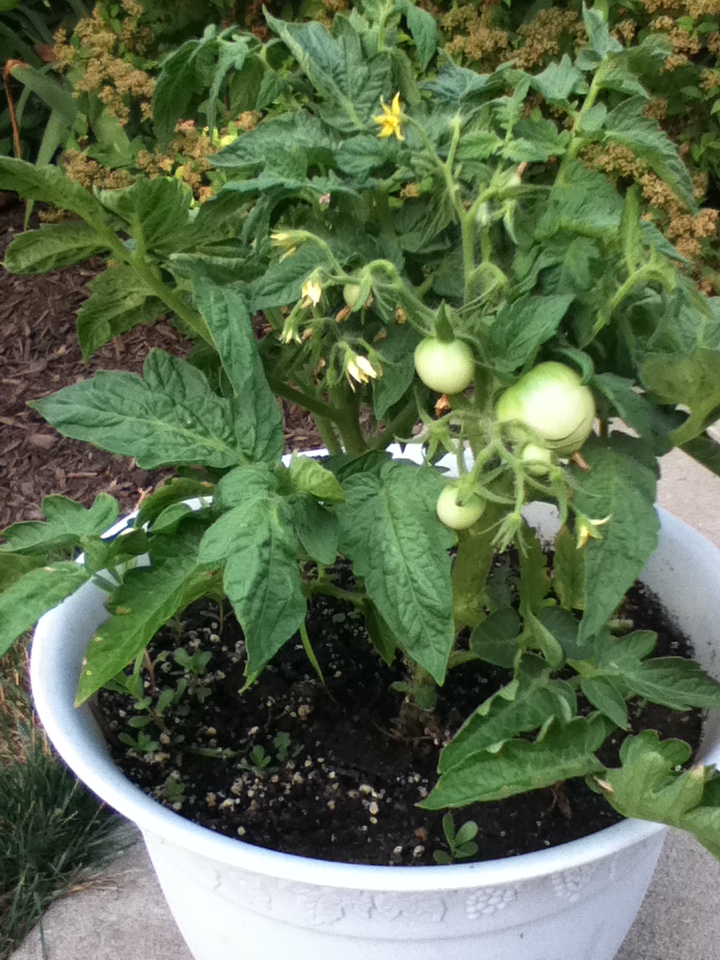
you are growing tomatoes in a planter,
not knowing whether you’ve placed
it in the right spot. Last year
you tried planting in the flower bed
but there was too much shade and there
were never any tomatoes. The year before,
you planted too late, and it was a rainy cool summer,
and the plant did not thrive. So this year,
you’ve decided to try using a movable planter.
You can target the sunniest place and control
the amount of water you’ve given the
plant. If there is too little sun,
or if the weather turns out to be
poor, then you can move the planter
for a better day. It is imprinted
on your mind that after you’ve exhausted all
other possibilities, that which remains,
however improbable,
must be the solution^.

And you like fresh tomatoes.

*******

^paraphrasing Sir Arthur Conan Doyle

Now comes the part where…

We all make lists.

I like lists because they 1) help me remember things and 2) I have a sense of accomplishment when I can mark something off the list. This is particularly true with activities and goals. I like seeing a piece of paper with lines through items.

So with the new year rapidly approaching, I thought that I would put a list here on the blog…not that I have a tremendous following that cares. It seems like a natural place to put stuff like that.

Things I want to do better in 2012
So here goes…
1. Read more books, one at a time – I am a bad parallel reader. I try to read too many things at once. It doesn’t work. Best thing ever – Books on Audio for commutes.
2. Get more exercise – Yeah I know, this is used every year and I give up the ghost every March or so. Consistent, paced activity…that’s all I’m shooting for this year. I want to be healthy, shouldn’t you?
3. Make more money – I know that sounds materialistic. Be real, we all want that, especially in this era of poorly performing stock funds. Actually, I want to be a better steward of what I have been blessed to receive. In that way, it would seem like I am making more money.
4. Have some more poetry published – I do write because I enjoy it, but everyone craves acceptance. I’ve had one item published online (see links), and I’ve been notified that a couple of other poems will be also published online during the first few months of 2012. Stay tuned for more information.
5. Come up with a 10 year plan – I’m approaching what should be the twilight years of my career and I want to have more goals in my back pocket. New interests, travel, any ideas?

What about you? You hearty few who might stumble upon or follow this blog…:)

What are your goals? How do you feel about lists?

Happy New Year to you. I wish you the best in 2012. Work hard, have fun, and be safe.

John

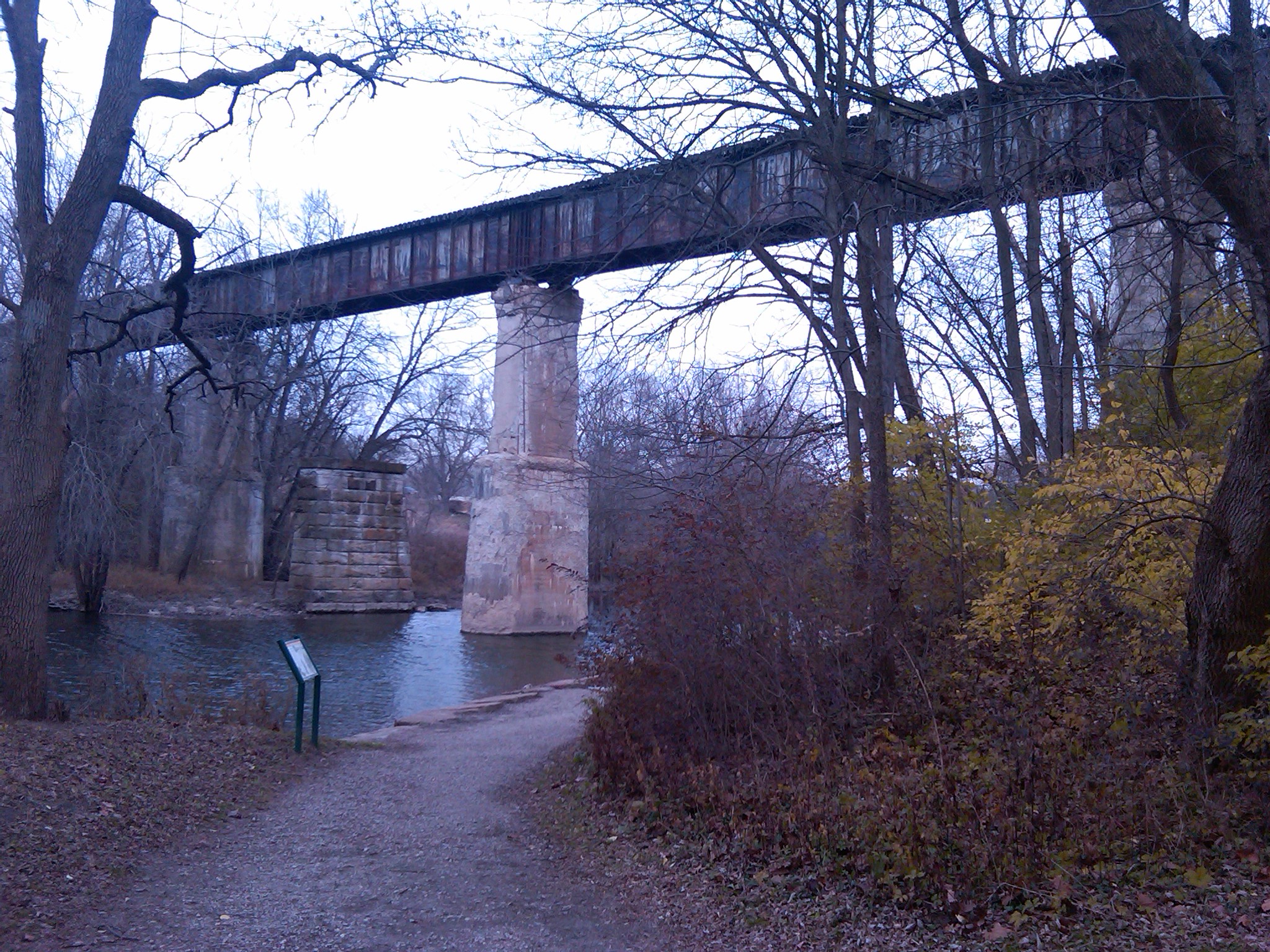
Where the road intersects

very near the river,
just below the old railway line
and across from the covered deer path
that veered into the unknown,

we discussed our own trails
some thirty years apart.

I had walked it.

He was a cross-country runner.

I recognized the race path
and never once assumed
it to be repeated.

Yet, for a while, he ran in my footsteps
and was running the hills smart.

Meanwhile other runners passed intermittently,
and we handed them cups of water and
they would douse themselves,
discarding the trash along the way.

We picked up the litter
so the path would be as we found it.

-unscarred and ready for travel.

Becoming

If you cannot be a poet, be the poem.
~David Carradine

I struggled,
no…toiled
quietly.
with the puzzle
of what was to be my next poem.

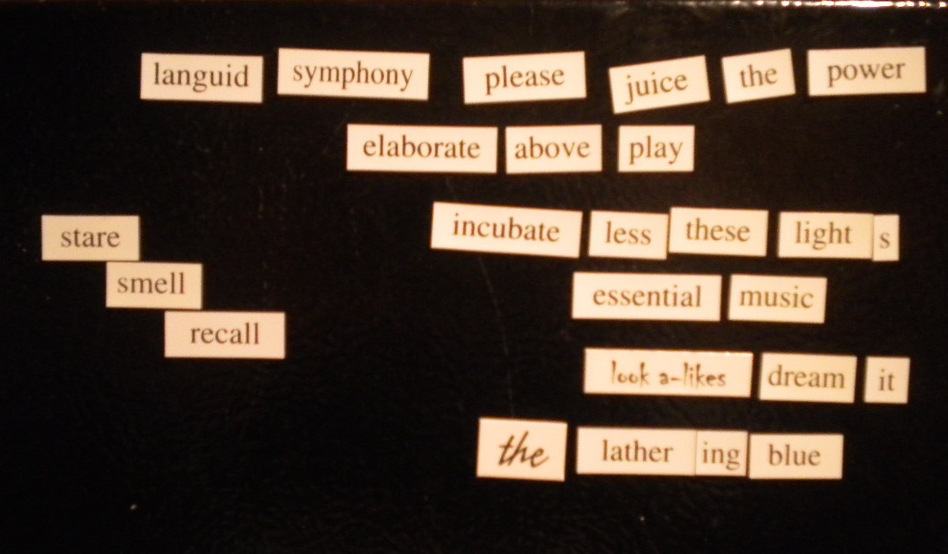
Separating the magnetic pieces of words
on the table.

Shuffling them into phrases
and finding
only prepositions
and adverbs:
Often before,
Sometimes between,
but mostly among
all of the words.

An admirer asked,
“Have you written anything recently?”
with a nod and held-breath and widening eyes

I replied with a slow head-shake.
and a sigh,
then realized what I had not done

-placed myself inside the poem-

I left the table
words askew
until perhaps tomorrow.

But, they gave them apples

I watched them amass
in the end zone section
at the football game,
and I thought of them as dots on lines
moving to an endpoint,
accumulating momentum as they went.

It was not Eden, but it seemed ideal
when the band played songs that everyone knew
and they all sang along
in short bursts of unity and cooperation.

Then they lost themselves in the festive atmosphere,
trying to be heard
as individuals in the rushing mob noise.

Later, they were given apples to eat
from a wax-coated box.
Afterward, everyone walked away
in different directions
just as he or she deemed.

Each went to their own endpoint,
some accelerating and others not,
still seeking wisdom in each their own way.