Category Archives: nostalgia

This too shall pass

They are widening streets in the suburbs,
and I’m thinking of Frost’s two roads,
-the ones that diverged-
while I’m driving past orange barrels
that line the road in the construction zone,
trying to avoid hazards.
And as I wind my way
through the pillared gauntlet
that warns of rough road
and unlevel pavement,
I see that the roadside up ahead
clears and gives way
to trees that climb toward heaven.

These trees invite me to continue
on past where I can see.

I wonder how that change happens,
and it just does.

******

Also, just because I like the song, the video, and the idea of vast unconnected machine that ends up somewhere, Here is OK Go.

a cappella Friday: Madrigals

A cappella music (without instrumental accompaniment) is particularly enjoyable for me to listen to. As a poet (and an avocational musician), I am drawn to the similarities that poems and a cappella music have. Lyrical phrasing, meter, rhyming, and onomatopoeia mean so much to a cappella music, because it relies so heavily on the human vocal element.

*******************************
Yes, I know it is not Friday, but I’ve been working on this idea for a while, inspiration struck, and who am I to argue with the Muse.

A madrigal, it seems, has several definitions.
1. It is short poem, from Medieval times, often about love, and suitable for being set to music.
2. It is a song for two or three unaccompanied voices, developed in Italy in the late 13th and early 14th centuries.
3. It is a polyphonic song using a vernacular text and written for four to six voices, developed in Italy in the 16th century and popular in England in the 16th and early 17th centuries.

Having sung in small groups in my younger years, I remember many of these songs. They had terrific harmonies, moving lines. I never really thought of the lyrics then, but all of these were musical settings of poems. The arguments of poetic forms still occuring then, apparently.

O, that the learned poets of this time
who in a lovesick line so well can speak,
would not consume good wit in hateful rhyme,
but with deep care some better subject find.
For if their music please in earthly things,
how would it sound if strung with heav’nly strings?

The song was published in Orlando Gibbons’s First Set of Madrigals and Motets of 5 parts (1612). A snippet of a recording can be found here, or you can do a search on Spotify or some other internet music source.

Perhaps his best known madrigal is The Silver Swan. A beautiful recording is given here.

The silver Swan, who, living, had no Note,
when Death approached, unlocked her silent throat.
Leaning her breast upon the reedy shore,
thus sang her first and last, and sang no more:
“Farewell, all joys! O Death, come close mine eyes!
More Geese than Swans now live, more Fools than Wise.”

FRANCESCO PETRARCA, 1304-74, better known as just “Petrarch” provided a large trove of the Italian madrigal lyrics. His Canzoniere is a collection of love songs and sonnets. His sonnets are largely credited with saving the form from obscurity. There is a great deal of information about his Muse Laura, and the origins of his poetry.

Early madrigal music dates back to 14th century Italy as a developed two- or three-line verse supported by identical music. Over time, Italian madrigals were recognized as the beginning of “word painting,” the combining of text and music to create a feeling.

*At this time I can’t find an internet recording of the following madrigal to share, but the words in Italian alone are worthy of a read.

Come talora al caldo tempo sòle
semplicetta farfalla al lume avezza
volar negli occhi altrui per sua vaghezza,
onde aven ch’ella more, altri si dole:

cosí sempre io corro al fatal mio sole
degli occhi onde mi vèn tanta dolcezza
che ‘l fren de la ragion Amor non prezza,
e chi discerne è vinto da chi vòle.

E veggio ben quant’elli a schivo m’ànno,
e so ch’i’ ne morrò veracemente,
ché mia vertú non pò contra l’affanno;

ma sí m’abbaglia Amor soavemente,
ch’i’ piango l’altrui noia, et no ‘l mio danno;
et cieca al suo morir l’alma consente.

The Italian is beautiful just in sound alone (it is a Romance language, after all), the English translation (courtesy of http://petrarch.petersadlon.com/canzoniere.html?poem=141) goes like this…

As at times in hot sunny weather
a guileless butterfly accustomed to the light,
flies in its wanderings into someone’s face,
causing it to die, and the other to weep:

so I am always running towards the sunlight of her eyes,
fatal to me, from which so much sweetness comes
that Love takes no heed of the reins of reason:
and he who discerns them is conquered by his desire.

And truly I see how much disdain they have for me,
and I know I am certain to die of them,
since my strength cannot counter the pain:

but Love dazzles me so sweetly,
that I weep for the other’s annoyance, not my hurt:
and my soul consents blindly to its death.

The form evolved over the years and by the 16th century consisted of a refined four to six parts, offering twelve lines of lyric verse with love, desire, humor, satire, politics, or pastoral scenes as the theme. Gibbons and Sir Thomas Morley (1557-1602) are among the more prolific writer/composers of the period.

My bonnie Lass she smileth

When she my heart beguileth. Fa la. . . . .
Smile less, dear love, therefore
And you shall love me more. Fa la. . . . .
When she her sweet eye turneth
O how my heart it burneth! Fa la. . . . .
Dear love, call in their light,
Or else you’ll burn me quite! Fa la. . . .

Finally, the madrigal has been parodied, quite successfully

Peter Schickele (PDQ Bach) penned “My Bonnie Lass, She Smelleth” as a parody of Morley’s “My Bonnie Lass She Smileth”

My bonnie lass, she smelleth,
Making the flowers Jealouth.
Fa la la (etc.)

My bonnie lass dismayeth
Me; all that she doth say ith:
Fa la la (etc.)

My bonnie lass; she looketh like a jewel
And soundeth like a mule.
My bonnie lass; she walketh like a doe
And talketh like a crow.
Fa la la (etc.)

My bonnie lass liketh to dance a lot;
She’s Guinevere and I’m Sir Lancelot.
Fa la la (etc.)

My bonnie lass I need not flatter;
What she doth not have doth not matter.
Oo la la (etc.)

My bonnie lass would be nice,
Yea, even at twice the price.
Fa la la (etc.)

Singing Hey Nonny Nonny Nonny No.
Divination

I’ll set out to find a chair, one that plushly – sitting there-
holds the moments that we share in a room otherwise bare.

One where lounging legs are strewn over armrests- fabric-sewn-
a soft and tufted, royal throne, this chair I dream of…want to own.

A fitting place to read a book over chores we once forsook:
Laundry, cleaning, or to look for recipes you meant to cook.

Would you like to find this seat, where love could coo, thus replete
with passion’s coverlet so sweet – an unobtrusive place to meet?

A cozy, spacious sincere stand, neither is austere nor grand
a sanctum with no harsh demands for time and memories – some unplanned.

Such as that I wish to see- not a fancy couch/settee-
Simply placed, for you and me, a place to live and laugh and be.

chair

Bells

bellsThings I’ve done in the last 48 hours.

– Baked 6 loaves of special holiday whole wheat bread, with cinnamon and brown sugar*.
– Delivered 4 loaves of the aforementioned bread as gifts to friends
– Ate 3/4 of 1 loaf of the aforementioned, remaining bread
– Searched TV menu for decent Christmas programs, finding none.
– Watched 1/3 of each of the LOTR movies
– Finished Christmas shopping for 6 gift cards, 1 bracelet, 2 sweaters, 6 bottles of shampoo/lotion that I can’t smell, and 2 or 3 things that were bought that I’m not sure what happened to them.
– Drank 1 bottle of Magic Hat #9
– Bought 2 large packs of AA batteries
– Watched the final 2 minutes of 2 different NFL games
– Washed 3 loads of my son’s college laundry to get it out of the floor
– Listened to 1/9th of my 9 hour Spotify Christmas playlist
– Played ukelele for 5 minutes
– Assembled 1 rolling rack
– Ventured out twice to the local megamart after I specifically stated that I wanted my errands completed early, so I would have to experience the last minute madness…yet I forgot 2 things…at 2 different times.
– Pondered how to write a 1 Christmas post that could accomodate my desire to recognize one of my favorite carols/poems.
– Wrote the following sentence – Henry Wadsworth Longellow wrote a poem in 1863, entitled “Christmas Bells.”

It was written on Christmas Day 1863, likely as a result of the news that Longfellow’s son Charles had been wounded in Civil War action earlier that year…and the recent loss of his wife Frances. There is just a snippet below. I encourage you to search out the poem and read all of it. It is short by Longfellow’s epic lyrical poem standards**.

I heard the bells on Christmas Day
Their old, familiar carols play,
and mild and sweet
The words repeat
Of peace on earth, good-will to men!

It has been set to music twice. In 1878, the English organist, John Baptiste Calkin, used the poem with a melody he previously used as early as 1848. The more familiar version was set to music in the 1950’s by Johnny Marks (he of Rudolph the Red-nosed Reindeer fame). I’m partial to the Bing Crosby recording. However, google the recent recording by The Civil Wars, which is very inspiring, and in light of the poem’s origins, somewhat “poetic.”

Wishing you all a Happy Christmas.

********************
*A recipe handed down in the oral tradition from my father to me. Though it has origins in the Better Homes and Gardens cookbook.
**Pun intended

flipping records

record
it is when
all you hear
is a bumping sound
with a few short bursts of
crackle,
that you realize
the songs have all ended.

you must flip
the record to side two
or change out the record
to hear new songs.

-it doesn’t just switch itself-

neither can you pick and choose
your music with play-list ease,
without the drop sound of the needle scratching

-abruptly-

the music must play from beginning to end,
the way it was meant to be heard.

Travel: Catch as Ketchikan

This summer, my wife and I took the best. vacation. ever.

I’ve always wanted to go to Alaska. It ranked up there with Ireland, Maine, Switzerland…you get the idea. I am smitten with vast wilderness, mountains and fields of green and rock.


We took an Alaskan Cruise, which I highly recommend if you are looking for vacation ideas. Along with my parents (who had done the Alaskan cruise before) and my brother and his wife, we set sail from Seattle to head up the Inside Passage of the Alaskan Panhandle. A beautiful setting that words and even pictures don’t do justice. It is 360 degrees of wilderness. Pristine. (And so much more than I can describe in one post)

Our first stop on the cruise, after one day “at sea” was the town of Ketchikan. Our ship docked and we disembarked to explore.

Did you know that Ketchikan gets an average of 162 inches of rainfall a year? That’s an average of 13.5 feet. Yes…It was raining.

Climate is just one of the things that I think Alaskans just accept and deal with. The people we met seemed to be very satisfied with their pace of life and adapting to the challenges that Alaska offers.

After helping my father find an eyeglass nosepiece repair kit… Note to tourist areas…Let some brand name pharmacy set up shop in your area, so that people don’t have to walk a mile and enter every little tourist shop and ask if they have [fill in the blank]. Now, I know they WANT you to go into every little shop. But if you are looking for something specific then it might be more beneficial to have an obvious drug store and people wouldn’t get frustrated… I set off exploring.

I’m not a shopping kind of person, so I wanted to avoid the tourist trap souvenier places. I walked past the jewelry and tee-shirt shops…all of them bustling with activity… into the town.

Up a hill and stone’s throw from the Episcopal Church, I discovered the Ketchikan Public Library and City Museum.

Did I mention that it was raining?

I decided to visit. The library was closed. I’m not sure why, it was a Monday morning. But the museum was open. I like finding little known haunts like local bookstores, museums, and restaraunts .

And, I like to stay dry…so,

I contributed my donation to the city of Ketchikan, and stepped into the history of the town.

The flow of the room went counter-clockwise, starting with various native artifacts of the Tlingit people, natives of the area. Small totems and various toys and tools carved from wood and whalebone. Native people are such experts at using available resources, and their attention to detail is amazing.

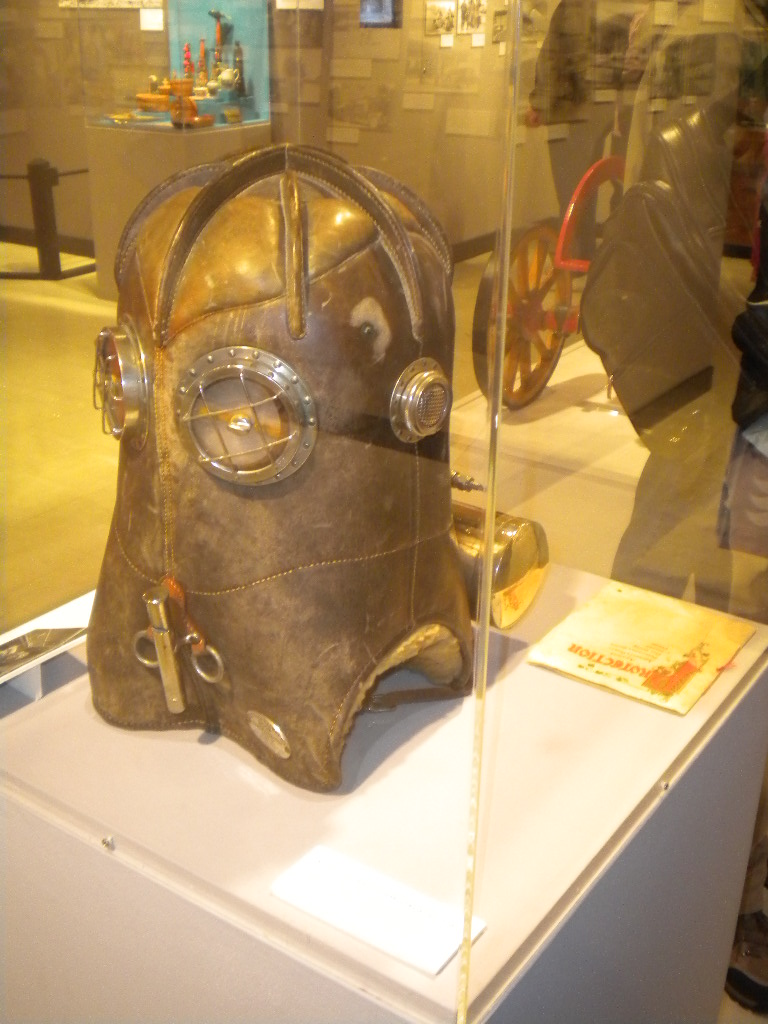
There were also items from the early pioneer settlers of the area and mementos from the heyday of the salmon fishing industry. Like this awesome gas mask to protect workers from the ammonia that was used in cold storage facilities.

I was fascinated by the pictures on the wall. The photo shown here, conveyed a baseball game played in 1912.  Because space was at a premium, they played games in the creek bed tide flats when the tide was out. The game would be called when the outfielders’ shoes got wet.

This, to me, was descriptive of the spirit of the settlers in Ketchikan.

Making things work.   Adapting.

Catch-as-catch-can.

Standards (a villanelle)

The piano chord was out of tune,
and during All the Things You Are
lovers kissed in the smoky room.

The singer’s skills I could not impugn
Yet on The Coast of Malabar,
The piano chord was out of tune.

The night was lit with a gibbous moon.
When you wish upon a star,
lovers kissed in the smoky room.

Melodies to which couples spoon.
Makes no difference who you are,
the piano chord was out of tune.

Embraceable you, the ladies swoon
Glasses set on the polished bar,
lovers kissed in the smoky room

The songs, they ended far too soon
I left the player a pourboire.
The piano chord was out of tune,
lovers kissed in the smoky room.

Postcard, January 1778

To my dearest one at home,

My limbs are cold and
the wind has scolded,
bitter nights of snow and ice.

The men, they huddle
’round the coal scuttle,
hoping flames will scourge the night.

From wint’ry Valley Forge,
Your Loving Husband, George

My dearest General,

Answering the latest message that you wrote,
Please use your thickest woollen coat
I cannot send you coal or fuel for flame.
I write my heart to you to use as same.

Remember, I shall see you in the Spring
When snow has melted, and the robins sing.
Until then, keep your warmth in heart,
as proof of strength and hope to start.

With all my love and deep affection,
your loving Martha Washington.

A cappella Friday: Yes!

OK…Here’s an interesting thought.

A cappella music (without instrumental accompaniment) is particularly enjoyable for me to listen to. As a poet (and an avocational musician), I am drawn to the similarities that poems and a cappella music have. Lyrical phrasing, meter, rhyming, and onomatopoeia mean so much to a cappella music, because it relies so heavily on the human vocal element.

**************************

The band Yes was/is an incredibly talented group from the early seventies and into the eighties (I know some form of them still tours, but we are talking hey day here). The musicianship of their albums is breathtaking. Symphonic rock, synthesizers, and intricate melodies all cemented their legacy. If you’ve never heard Roundabout, check it out.

Their 90125 album from 1983 was a shift to a more pop-oriented format. On that album was a unique song “Leave It“, done primarily a cappella. It definitely made an impression on me. There are some great harmonies in this song, along with some provoking lyrics.

I can feel no sense of measure,
no illusions as we take
refuge in young man’s pleasure,
breaking down the dreams
we make real.

Leave It lyrics © Warner/Chappell Music, Inc., DOWNTOWN MUSIC PUBLISHING LLC, CARLIN AMERICA INC

Listen especially to scat sounds the vocalists make. Groundbreaking for the time (early beat box).

Goodbye, goodbye, goodbye bad
Hello, hello heaven.

This is poetry…done with melody.

Old Greensboro

There is a crossroad there,
but you might miss it
if you drive too fast;
you won’t miss the town
because it is no longer there.
There is shady hollow a mile or so past
at the bottom of the hill.

-An easy landmark to let you know you’ve gone too far-

This countryside is hilly and forested
with Loblolly pines,
fast growing trees that reclaim ground,
and the ground is
red Yazoo clay that is always moving.

That should tell you something,

I heard tales of gambling and roughshod characters,
when this was a destination place
or on the way to somewhere.
That was before the railroad came in two towns over
and took away its “on the way to” status,
and people left.

Eventually, you had to be from there to know.

The roadsign holds the name “Greensboro”
about eight feet high,
and an old clapboard house stands
at the intersection.

It needs paint.

Behind the house
and to the right
is a well-tended cemetery
with a new tin-roof chapel. There are no ghosts.
My people tell of a confederate general buried
-in Old Greensboro-

He must have been from there.