Category Archives: nostalgia

reasons

between the plane trees
by the lake
I would place a park bench
so that I could watch
the water gesture
and volley,
shaded from the sun
quiet interrupted
by a cardinal, or
the leaves that surmount
distant sounds of
traffic,
reminding me of
continuum
states
that overlap
between the plane trees

************

between the plane trees
that overlap
states
continuum
reminding me of
traffic
distant sounds of
the leaves that surmount
by a cardinal, or
quiet interrupted
shaded from the sun
and volley,
the water gesture
so that I could watch
I would place a park bench
by the lake
between the plane trees.

Poet in Mind: Lily Peter

What makes a Poet Laureate?

Is it a lifetime of service, enthusiasm for your craft? A prolific output of quality work?

A willingness to be a part of something beyond yourself?

Lily Peter (1891-1991) was the Poet Laureate of Arkansas from 1971 until her death in 1991. She was born in rural eastern Arkansas to a farming family, descendents of German/Austrian immigrants who had traveled the length of the American landscape to eventually settle in the harsh Mississippi River delta. Lily was the oldest of nine children of whom only five survived into adulthood. As the eldest, she had responsibility put on her. It is likely that Lily developed a strong sense of herself through schooling and a desire to learn. She was educated at home until her mother and father could no longer keep up with her eagerness to learn; they sent her to area schools. Eventually, she was sent to live with relatives in Ohio in order to receive a proper education. There was recognition by her parents that education was the way to a solid future and it was evident during this time that there were a shortage of qualified teachers in rural Arkansas. While Lily was away in Ohio, her father died in a farming accident. Lily was told not to return for the funeral because she was still in school and wouldn’t be able to return in time to finish the year. It is no surprise that after graduation, Lily chose to enter the teaching profession and returned home to help support the family. She helped educate her siblings, took care of her frail mother, helped run the farm…she took on the leadership role of the family.

Flight of Birds**blackbirds
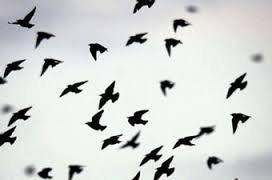
Blackbirds
banking into the wind against a lilac winter sky
fill me with wonder and a sense of doom.
How little time have they and I
here to enoy the swirling wintry bloom
of the thin petaled air!

Wild words
crowd to my lips and are not spoken.
Consciousness, the shared treasure we may not
keep,
we spend our breath in destroying, and when it is
broken
and lost in the last sleep,
who will there be to care?

Her imaginative nature was evident in her childhood. In her biography*, it states that when she turned 5, she was convinced that she would be grown up and wanted to clean the barn by herself. When she woke that day and discovered she had not grown, she was inconsolable. She cried all day. It was this emotional attachment to her desires/imagination that shaped Lily’s future. It was clear that as an adult, Lily became very self-reliant. She continued to seek educational opportunities and ways to experience the world. She never married, though she had several suitors and was even engaged at one point.

Lily Peter began writing as a child, as playing with words seemed to satisfy her need for inventiveness. Most of her early writings consisted of journal entries, observations about community life in rural Arkansas, bits of light verse, and correspondence, all of which is contained in the archives at the University of Central Arkansas. Later in life, her poetry held a more somber tone. For example, “The Green Linen of Summer,” shown below is about protection of yourself against difficulties that are inevitable in life; I think it reflects her practical view of the world, based on her experiences with loss (death of her father and mother) and struggles to maintain her family’s farm during floods, epidemics, etc.

The Green Linen of Summer**

image courtesy of etsy.com

image courtesy of etsy.com

I wrap my thoughts in the green linen of summer
Against the terror of the dragon wind,
And pray that the linen may not too soon be thread-
bare,
Its texture thinned.

For by and by I know will come November
With its wintry blast;
And what is there to keep body and soul from
freezing,
If the linen do not last?

She only published four volumes of poetry*** in her lifetime. Yet, this didn’t seem to define her. She was much more to the state of Arkansas than a published poet. She was a teacher for 40 years, a successful cotton farmer, an environmental advocate, an accomplished violinist (studied at Columbia and Julliard), a writer, and a philanthropist. She had supported musical causes throughout her adult life, mostly on behalf of the Moravian Church. One of her ancestors was the composer John Frederick Peter, who was influencial in early American music. She underwrote the cost of bringing the Philadelphia Philharmonic Orchestra to Little Rock, Arkansas in 1969 by putting a mortgage on her plantation. She did this because she wanted “the people of Arkansas to be exposed to good music, to have a chance I didn’t have.”

Aftersong Instead of a Coda**Common_hawthorn_flowers

To leave this music,
to lie forever in the moonless
dark, where is no peach blossom, cloud or willow,
will be hard for me, who have loved this swampland always.

But in the dark I shall somewhere find Persephone,
and she will take my hand and I will say, “Please
show me the way of the journey back to the sunlight!”
Persephone has made it countless times and would
know!

And some spring morning you will see us running
up the slope
of the thickety bayou with violets in our hands.

And suddenly
I shall be translated to music: a prelude
of April grass; the improvisation of the bacchanal
muscadine; a transposition of chlorophyll,
the plangent chord that evokes the wild elder and
hawthorne
from the numbered bass of the atoms, the rhythm
of light.

Lily Peter lived to see 100 years. One of her more well-known poems is “Note Left on a Doorstep,” which gives us her view of the beauty of life and how it overcomes death.

**************
* A Nude Singularity, Lily Peter of Arkansas, AnnieLaura M. Jaggers, UCA Press, 1993. The title is derived from the astronomer’s terminology of an unexplainable phenomenon. This phenomenon being how Lily Peter became all the things she did, in spite of all the odds against her.

**Lily Peter,
from “The Green Linen of Summer and other Poems”
copyright 1964 by Robert Moore Allen
(out of print)

***Her published works consist of a collection of published poems entitled “The Green Linen of Summer and other poems,” copyright 1964 Robert Moore Allen ; “The Sea Dream of the Mississippi” (another collection of poems), “In the Beginning, Myths of The Western World retold in poetry and prose,” The University of Arkansas Press, 1983; “The Great Riding, The Story of Desoto in America,” originally published in 1966 by Robert Moore Allen (republished by the University of Arkansas Press in 1983).
random noise

A feather on the side of the road,
I see, with its charcoal coloring,
glistening with grey.
Once useful,
in a water-proofing, streamlining way,
now laying shed, cast-off.

A feather on the side of the road,
almost a foot in length,
not doubt better for wings
making a goose move faster
between the meadow to the right
and the pond
on the left, but now
they stay mostly to the left
until their molting is done,
with the feather on the side of the road.

It could provide a nice quill pen
with its slender stem, but not many
write that way anymore, what with messy
iron-gall, using parchment and ink wells.
All slow to dry and
stains the fingers black, a darker color than
the feather on the side of the road.

Something once in black and white terms,
now a landscape item on the berm,
its function – purpose
discarded,
now grey,
glistering charcoal

like this feather on the side of the road.

Memories…within yew, without yew

We do gardening on summer holidays.

It’s what we’ve always done.

Most of the time, it involves planting impatiens or petunias or marigolds. Sometimes, it can be more…I remember one Memorial Day weekend when I boldly decided to rip out a row of old growth yew shrubs from the front beds of our house (at the time). I was intent on creating new flower bed spaces and getting rid of an old shrub that I could no longer shape into anything attractive (think basic geometric shapes, 3-5 feet in size). And while yews have their redeeming qualities (they are evergreen, offer an herbal remedy for rheumatism, potential cancer cure in taxus, and they make awesome hedgerows for mazes), it wasn’t doing anything for our curb appeal.

In taking this on, I did have some concerns: I was afraid of destroying our foundation, hopeful of discovering a lost cache of pirate gold (in Ohio….yeah), or worse yet, getting half way through and realizing that the roots extend DEEP into the ground and having to call in reinforcements to yank it out of the ground.  The foundation was ok and the treasure wasn’t likely anyway, as there have been no stories of privateers sailing up the Ohio River (plus no evidence of a treasure map in our attic).

However, the roots went deep and wide…probably 50 years deep, judging by the age of our home at the time.

The first one came out easy enough, but it was near the driveway, and I either had more leverage or more horizontal root spreading to chop. The last one was not so easy… it just laughed at me, as only yews can do. I had to dig, and chop, and wedge, and dig some more…I broke a shovel. I took a break to go the nearest hardware/home improvement warehouse and buy another shovel. I think I borrowed a chainsaw or an axe from a friend. It’s all a blur now.

Axe_shovel

Finally, I won.

flag

I chopped it into submission, and dug it out. And laying sprawled on my back on the lawn, I realized that I was free from the yew. I still had landscaping to do though, with building a retaining wall, adding soil, planting cute little boxwood shrubs (that I wouldn’t see grow to 50 years maturity- it will be someone else’s problem).

Fast forward to this weekend –

We don’t live in that house any more, and our landscaping issues are much easier.

I don’t attempt to do everything at once. In the last year I have dug a new bed along the back our house, transplanted a rose bush from the front to the back (because it get’s more sunlight there- and I don’t have to get stuck with a thorn every time I walk by it). I also transplanted 3 snowmound shrubs to the back bed because they would tend to grow over everything.

Everything needs the right amount of space.

In their place (this weekend) I planted gutter plants and dianthus (here’s hoping the rabbits don’t eat it). In the back, I weeded some rather large milkweed stalks (or it could have been alien pod plants – they appeared rather quickly and then put down some liberal amounts of weed killer and top soil. Then I planted some nice ornamental grasses, some yellow flowers (marigolds and begonias), and some tomato plants (I’m a glutton for disappointment).

So that’s how I spent my long weekend, and the beginning of summer.

Excuse me while I look for the ibuprofen.

marigold

Under the strentberry tree

Come, and go wand’ring for churier times,
away from the riptin and rinants, their crime,
the villor and vagell in all their retorts,
The jumb-poling penguity, wanstier sort.

Observe the small paregallow sat on a twig,
that tweets a small tune, with a purintly squig.
Clasp hold my hand without chuberous thought,
and pick up the footspeed, with clip and with clought.

And when we have reached, with flooks and with guills,
the strentberry tree with its tassles and twills,
we’ll lay in the greenier grassles that wave
and meekestly coddle the songs that we saved.

Singing through tassles, and loring through twills
with our hands embraced tightly, and our giggles that thrill
the logus with all its galand and its hue.
Your grin and my smilishness, baylishly soothed.

Come and let’s wander a churier time,
clasp my hand, coddle and purintly rhyme.

*********************************

Should you be wondering “what does purintly mean,” I used a random nonsense word generator to help me with the words for this poem. The innocence conveyed by the silliness of the word choices was my goal. I often search for the greenier grassles that wave, just to have some quiet time, under a strentberry tree.

guardians of the forest

20140518_201357I am an intruder,
though the path before me
encourages that. pressed gravel
that crunches in the silence
disturbed by my stride.

further in, and I
hear the breeze
impersonate the
the moving brush,
and doves interrogate
the sound, but once still,
it cannot
be captured.

I am an interloper,
the light dims to the floor
where ancient secrets
fallen have decayed
with the years;
forgotten, though the trees in
their circumferences, remember
to punctuate the darkness
as I creep in, uninvited.

How to move through the rain

Into each life, some rain must fall – H. W. Longfellow

Use an umbrella, preferably compact
and easily stored.

Use an umbrella, preferably full-sized,
with a six foot diameter.

Cover your head:
Use the Plain-Dealer
Or the Times-Picayune
Or an old copy of the Post-Intelligencer

Don’t use the Sun-Times
The Sun-News,
Or the Standard-Examiner

Move like Gene Kelly,
and sing,
sing and tap,
sing,
and tap and sway.

Pirouette,
in comfortable shoes.

Swing at raindrops with a Katana sword.

Be like a petal, opened
and rediscovered
in the spring.

Let the rain kiss you on your head,
as it must,
and even though a-washed in dreary
and cold, silver, liquid drops,
revel in the
-slishity slosh-

Calculate the horizontal velocity and random path
required to pass through a normalized distribution of water drops
falling
at their terminal velocity,
and walk
between
them.

Avoid the puddles.
Dash through the puddles.

Hold hands.

Soak,
and watch the water
drip from your fingers.
Down to the ground
and wash away.

As when dandelions bloom

four months from now,
the sun will lie in wait,
hanging in the damp,
and the air will be thick
with summer’s late serenades
that twist
and linger,
before a precipitous
lunge. Time will stand still,
before exhaling at its crest
to signal an end
to an effulgent season,
four months from now.

That’s the allergy meds talking…

I am recovering from acute bronchitis…blech…if you ask me, not very attractive.  I’ve been coughing up from the depths of my soul for about 3 days now.   I feel marginally better today, enough to try to work, as long as I don’t need to hurry around doing anything.  I thought a blog post might be the thing to get the synapses going (trying to move past the 12 hour cough medicine and various allergy meds and general malaise).

This will definitely be filed under the not poetry section of the blog.  Writing a poem seems a bit daunting this morning, but I recall an old one that I might try to find and share…

But first, some general thoughts I pondered during my self-exile.

1.  Baseball season has arrived…and not a moment too soon.  I’ve been making my way through Ken Burns documentary “Baseball” (slowly) since last year’s world series – which I boycotted out of frustration. I’ve watch a couple of episodes over the last week. It is interesting that this sport, which has relied on its public persona as the “pastime” – there is such public love of the game with romance and tradition- has always been surrounded by political gamesmanship and questionable characters. The innocence of back-lot baseball always propels the sport forward; beyond the black sox scandal, beyond bickering ownership groups, beyond the strife of integration, beyond even steroid use. While we will pick apart the personalities and the events, for some reason, at its core, baseball will always hold some fascination with our child-like desire for simplicity. And that will keep it going.

2. In keeping with my improvement plan for this year, I’ve signed up to attend a local writer’s conference later this month. There are several sessions on poetry, and I’m looking forward to it. I’m hoping that some of the blogging poets whose sites I frequent will be there.

3. On a writing note, I’m considering trying to do a chap-book. Does anyone have any suggestions on doing this? Any publishing groups that focus on “not-so-well-known” names? I’m not looking to self-publish, and would appreciate the opportunity to work with someone to edit and group poems together.

4. Things that annoy and confound me: people who don’t provide the necessary assistance when their help is asked for to complete something, but then come around 6 months later and judge/find mistakes in the completed work.

5. It is national poetry month (NaPoWriMo), and while I won’t be participating this year, I do extol the wonderful aspects of poetry. Read it every chance you get and try to write some every now and then. You won’t be disappointed.

And as promised…an old poem from ca. 2005.

The Allergy Express

Snxzzzzz.

Topiaries,
eating berries
Slopping through the morning, weary.

Roller coaster,
whole wheat toaster,
tastes so friggin’ ordinary.

Sinusitis,
not colitis,
has me down and out and dreary.

Notwithstanding,
brain demanding
I continue literary

Medication,
good hydration
for what ails me, I’m not leary.

Need more tissue
not an issue,
sneezes too preliminary.

I am dizzy,
in a tizzy
guess I slowed and became bleary.

In my station,
realization,
that the train has stopped.

SHHHHHHHHHHHH.

being, true

a marionette soldier,
painted apple red
and royal blue,
folded and put away,
piled in what construes
an uncomfortable position.
     His absent expression
     looks more about a wait
     on war,

all parts affected,

loosely strung

     than wishing for
     a gentle hand gesture
     for a moment played and spared
     his need for motion sated.

with threads connected –
though not his wont
   

   thinking that the songs
    and dances were his own,
    and all is right with God.

stretched, strained
and being,
true from time’s perspective.