Category Archives: knowledge

doppler collusion

speak the sound,
then it resonates back
in waves that traverse time,
sometimes delayed.

When I was a child,
I used a tape
recorder to
compose sounds
and mimic noises and
imitate voices from what I heard.

Then played them back.

They were old,
voices
from movies and
TV shows, trustworthy sounds
to my ear, both as I spoke them and
as they were played back to
me from the tape.

sometimes
Stan Laurel wouldn’t
come out the way I heard him
when I spoke,

and I realize now,
I was only six.

***********************
NaPoWriMo 2013, Day 6

On a rock

The incantations of the morning
rose with the mist
among the open walls
and cast-about ruins of the facade.

No alleluias
drifted from the chancel,
silenced long ago.
Yet, a whisper crept past
my ear to look up
at the garden wall, past
where roses once stood.

The sun met skewed blossoms
growing from the mortar,
casting shadows.

Here, something built
to extol eternal majesty,
a victim to weathering and decay.
Now, its fragments and remains
laid bare to anchor wildflowers,
set there by circumstances,
in gaps and sills of battered stone.

A cappella Friday: To Be Sung on the Water

A cappella music (without instrumental accompaniment) is particularly enjoyable for me to listen to. As a poet (and an avocational musician), I am drawn to the similarities that poems and a cappella music have. Lyrical phrasing, meter, rhyming, and onomatopoeia mean so much to a cappella music, because it relies so heavily on the human vocal element.

*****************************

There are few things more lovely in nature than the calm surface of a body of water. The way a rowboat or canoe cuts through the still waters is direct, and appeals to one’s sight. The sounds of oars dipping into the surface and being pulled forward, leaves an echo. If there are no other sounds around, the setting is serene.

Louise Bogan (1897-1970) was a poet of the early/mid 20th century. She was born in Maine, into a family of mill workers. As a child, she was unfortunately witness to the adulterous affairs of her mother, which definitely shaped her views on love and betrayal, a common theme in her poetry. Most of her poetry was written early in her life. Later in life she worked as a poetry reviewer for the New Yorker. Bogan was fairly reclusive and reticent about sharing personal details of her life. Her poetic voice has a deep romantic resonance, and she manages to pull every bit of emotion out of minimal use of words. Among her works is a poem entitled “To be sung on the water”.

TO BE SUNG ON THE WATER
By Louise Bogan

Beautiful, my delight,
Pass, as we pass the wave.
Pass, as the mottled night
Leaves what it cannot save,
Scattering dark and bright.

Beautiful, pass and be
Less than the guiltless shade
To which our vows were said;
Less than the sound of the oar
To which our vows were made, –
Less than the sound of its blade
Dipping the stream once more.

Samuel Barber (1910-1981) was a highly prolific American composer. While his best known work is arguably Adagio for Strings^, he also wrote vocal music and was highly acclaimed as a choral/vocal composer. He was an avid fan of poetry and composed works based on poems by Matthew Arnold, Percy Bysshe Shelley, and James Agee. In 1968, he composed a choral setting of Louise Bogan’s poem ” To be sung on the water.” There is no indication that Ms. Bogan ever heard a performance of this piece, but perhaps she would have nodded in agreement.

It is hauntingly beautiful.

^Adagio for Strings has been used in the soundtracks of The Elephant Man, Lorenzo’s Oil, and Platoon, as well as several other films.

genesis

R.S. Wesson

Original Art – R.S. Wesson


at the beginning
there was a blank sheet,
and in the darkness
creation was held in place
before the sparks and ember glows
set their marks in the distance.

a sound arose from the corners
of the universe
and echoed
with a sun’s laugh of approval

while luminous seeds flew from a nova,
floating outward
in waves of solar mirth,
and left an imprint of light and sound
set with the hand that created it.

**************
Genesis is an ekphrastic poem, inspired by the artwork shown above, by R. S. Wesson.

This too shall pass

They are widening streets in the suburbs,
and I’m thinking of Frost’s two roads,
-the ones that diverged-
while I’m driving past orange barrels
that line the road in the construction zone,
trying to avoid hazards.
And as I wind my way
through the pillared gauntlet
that warns of rough road
and unlevel pavement,
I see that the roadside up ahead
clears and gives way
to trees that climb toward heaven.

These trees invite me to continue
on past where I can see.

I wonder how that change happens,
and it just does.

******

Also, just because I like the song, the video, and the idea of vast unconnected machine that ends up somewhere, Here is OK Go.

Requiem for Enope

Watasenia scintillans
Darting in the deep cyan,
Sparkling as the firefly might
Commencing dusky summer nights.

You and all your kindred shine
Dancing in the deep’ning brine,
Flash and glint and find your way,
Interlace, caress and play.

Flicker to attract the one
Who kindles and ignites the sun.
Bathe in being at your prime
Until your light fades faint with time.

A life so short, a stature small
blush and glimmer for us all.

Adventures in Productivity

Early Sunday morning, I awoke with the idea that I wanted to make a loaf of sourdough bread. I received a breadmaker from my son as a Christmas gift. I have enjoyed making bread “the old fashioned way” for many years, and entertained the idea of a breadmaker because, well, I like bread, and sometimes there is not enough time to mix ingredients, let it rise, divide the dough, let it rise again, and cook it. I will do it that way for holiday bread, but it is time consuming.

Scrounging around the kitchen at 7 AM, I realized that I did not have enough all-purpose flour to complete the recipe. What I did have was whole wheat flour. I have never heard of whole wheat sourdough bread…so I went to my computer to google search.

My internet connect was dead.

We have a funky wireless connection at our house. It drops out my wife’s laptop most of the time, but rarely does my computer lose the signal. I rebooted the modem…nothing. I rebooted my computer….still nothing.

The definition of insanity is, doing the same thing over and over and expecting a different result.

I rebooted everything again…just in case. No luck.

Then I took an ethernet cable and hooked my computer directly to the modem…good,

then to my wireless router…bad.

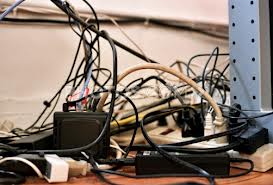
tangled wires

I am fortunate to have purchased a spare router^, so I powered everything down, replaced the router, plugged everything in, powered it up and …..BAM….

working internet.

Amazing.

A little searching for bread recipes and I found the following:

A hearty whole wheat yeast bread with the tangy flavor of sourdough. This recipe was written for use with bread machines.

Sourdough Whole Wheat BreadFor 1 1/2 Pound Loaf:
3/4 cup plus 2 tablespoons water
2 tablespoons vegetable oil
1 cup sourdough starter (room temperature)
1 1/2 teaspoons salt
1 tablespoon granulated sugar
3 cups whole wheat bread flour
2 teaspoons active dry yeast

I loaded the ingredients in the breadmaker, plugged it in and pressed start.

Three and a half hours later, we enjoyed a warm loaf of whole wheat sourdough bread with lunch. It did not have an extra heel, but we were joyful nonetheless.

bread
********************************

Why does this matter?

I have been reading Steven Johnson’s book, Where Good Ideas Come From: The Natural History of Innovation. It is one of the five or six books (paper and electronic) that I have cracked open at the moment^^. He discusses the coral reef as a model for technology development – filling the needs required by those in the environment so they don’t have to reinvent something from scratch to fill their need.

Adaptation to the situation via the adjacent possible.

To make a loaf a bread required not only the ingredients (whether I could use whole wheat flour or not), the knowledge of how to mix them and cook the loaf, the technology of a bread machine, how to troubleshoot an internet connection, performing a search of information out in cyberspace…you see where this is going right?

Steven Johnson’s point is that we don’t have to know how all of these things work, but simply how to use them. That opens up the adjacent possible…If I use it there, maybe I can use it here.

That is how new ideas are born.

Trying the bread with a little margarine and apple butter is my next big idea.

*********************************

^We purchased a certain provider’s bundled internet and phone package a few years ago, only to find out recently, when our phone connection went out, they no longer support the equipment…so we have to do that on our own. I found what we needed and we purchased a few of them.

^^Yes, I can’t seem to finish a book without starting another. I won’t apologize for that any longer.

a cappella Friday: Madrigals

A cappella music (without instrumental accompaniment) is particularly enjoyable for me to listen to. As a poet (and an avocational musician), I am drawn to the similarities that poems and a cappella music have. Lyrical phrasing, meter, rhyming, and onomatopoeia mean so much to a cappella music, because it relies so heavily on the human vocal element.

*******************************
Yes, I know it is not Friday, but I’ve been working on this idea for a while, inspiration struck, and who am I to argue with the Muse.

A madrigal, it seems, has several definitions.
1. It is short poem, from Medieval times, often about love, and suitable for being set to music.
2. It is a song for two or three unaccompanied voices, developed in Italy in the late 13th and early 14th centuries.
3. It is a polyphonic song using a vernacular text and written for four to six voices, developed in Italy in the 16th century and popular in England in the 16th and early 17th centuries.

Having sung in small groups in my younger years, I remember many of these songs. They had terrific harmonies, moving lines. I never really thought of the lyrics then, but all of these were musical settings of poems. The arguments of poetic forms still occuring then, apparently.

O, that the learned poets of this time
who in a lovesick line so well can speak,
would not consume good wit in hateful rhyme,
but with deep care some better subject find.
For if their music please in earthly things,
how would it sound if strung with heav’nly strings?

The song was published in Orlando Gibbons’s First Set of Madrigals and Motets of 5 parts (1612). A snippet of a recording can be found here, or you can do a search on Spotify or some other internet music source.

Perhaps his best known madrigal is The Silver Swan. A beautiful recording is given here.

The silver Swan, who, living, had no Note,
when Death approached, unlocked her silent throat.
Leaning her breast upon the reedy shore,
thus sang her first and last, and sang no more:
“Farewell, all joys! O Death, come close mine eyes!
More Geese than Swans now live, more Fools than Wise.”

FRANCESCO PETRARCA, 1304-74, better known as just “Petrarch” provided a large trove of the Italian madrigal lyrics. His Canzoniere is a collection of love songs and sonnets. His sonnets are largely credited with saving the form from obscurity. There is a great deal of information about his Muse Laura, and the origins of his poetry.

Early madrigal music dates back to 14th century Italy as a developed two- or three-line verse supported by identical music. Over time, Italian madrigals were recognized as the beginning of “word painting,” the combining of text and music to create a feeling.

*At this time I can’t find an internet recording of the following madrigal to share, but the words in Italian alone are worthy of a read.

Come talora al caldo tempo sòle
semplicetta farfalla al lume avezza
volar negli occhi altrui per sua vaghezza,
onde aven ch’ella more, altri si dole:

cosí sempre io corro al fatal mio sole
degli occhi onde mi vèn tanta dolcezza
che ‘l fren de la ragion Amor non prezza,
e chi discerne è vinto da chi vòle.

E veggio ben quant’elli a schivo m’ànno,
e so ch’i’ ne morrò veracemente,
ché mia vertú non pò contra l’affanno;

ma sí m’abbaglia Amor soavemente,
ch’i’ piango l’altrui noia, et no ‘l mio danno;
et cieca al suo morir l’alma consente.

The Italian is beautiful just in sound alone (it is a Romance language, after all), the English translation (courtesy of http://petrarch.petersadlon.com/canzoniere.html?poem=141) goes like this…

As at times in hot sunny weather
a guileless butterfly accustomed to the light,
flies in its wanderings into someone’s face,
causing it to die, and the other to weep:

so I am always running towards the sunlight of her eyes,
fatal to me, from which so much sweetness comes
that Love takes no heed of the reins of reason:
and he who discerns them is conquered by his desire.

And truly I see how much disdain they have for me,
and I know I am certain to die of them,
since my strength cannot counter the pain:

but Love dazzles me so sweetly,
that I weep for the other’s annoyance, not my hurt:
and my soul consents blindly to its death.

The form evolved over the years and by the 16th century consisted of a refined four to six parts, offering twelve lines of lyric verse with love, desire, humor, satire, politics, or pastoral scenes as the theme. Gibbons and Sir Thomas Morley (1557-1602) are among the more prolific writer/composers of the period.

My bonnie Lass she smileth

When she my heart beguileth. Fa la. . . . .
Smile less, dear love, therefore
And you shall love me more. Fa la. . . . .
When she her sweet eye turneth
O how my heart it burneth! Fa la. . . . .
Dear love, call in their light,
Or else you’ll burn me quite! Fa la. . . .

Finally, the madrigal has been parodied, quite successfully

Peter Schickele (PDQ Bach) penned “My Bonnie Lass, She Smelleth” as a parody of Morley’s “My Bonnie Lass She Smileth”

My bonnie lass, she smelleth,
Making the flowers Jealouth.
Fa la la (etc.)

My bonnie lass dismayeth
Me; all that she doth say ith:
Fa la la (etc.)

My bonnie lass; she looketh like a jewel
And soundeth like a mule.
My bonnie lass; she walketh like a doe
And talketh like a crow.
Fa la la (etc.)

My bonnie lass liketh to dance a lot;
She’s Guinevere and I’m Sir Lancelot.
Fa la la (etc.)

My bonnie lass I need not flatter;
What she doth not have doth not matter.
Oo la la (etc.)

My bonnie lass would be nice,
Yea, even at twice the price.
Fa la la (etc.)

Singing Hey Nonny Nonny Nonny No.